Quantcast
Channel: Poached Egg Woman
Viewing all 78 articles
Browse latest View live

Into the Hawthornes

$
0
0

Down on hands and knees

through the door of thorny branches,

just big enough

and into the hawthornes

right in the middle


sssshhh…if you can stay quiet

long enough

they come back

the birds, the squirrels

to eat the red berries


if you can stay as still as a hawthorne

you can hear the soft wingbeat of a fairy


if you can stay quiet

you can catch the scent

of the coyote who slept here last night

you can feel the slow heartbeat of the earth

that is holding you

loving you

back to life


The post Into the Hawthornes appeared first on Poached Egg Woman.


Letter to the Editor – Elegy for the Trees

$
0
0

Letter to the Editor of the Fort Qu’Appelle Times, December 2016

I am concerned about the practice of removing trees, “pushing bush”, and draining sloughs that is happening at an unprecedented rate on farmland in our area and beyond.

I walk our road almost daily. This gives me a chance to observe the wildflowers, the varieties of wild creatures including butterflies, dragonflies, bees, deer, coyote, fox, skunks, frogs, snakes and birds of all kind who make their life here. 

Last fall, a landowner bulldozed a group of trees that I have come to know very well. Not only do yellow lady slippers bloom in the shelter of these beautiful aspen, but many other creatures find refuge there as well. This was just one of a group of aspen bluffs and low lying sloughs in this area that was bulldozed. A year later, the piles of brush were set on fire and left to burn for a few days, then buried under the ground. Walking past now, it looks as if there never were trees there.

I called the landowner to share how sad and distressed I felt about the loss of these trees, as well as the scale of the destruction of similar places. He listened respectfully and thanked me for sharing my thoughts.  I invited him to come for a hike with me next spring to see how these wild places are brimming with natural life. I cannot tell another landowner what to do on his land, but I can share how I feel about it. Having a conversation with my neighbour may not change anything but at least he knows how I feel.

I know farmers who love the natural world and think hard about how their decisions affect the environment. I acknowledge that farmers sometimes do need to remove trees on their land. It is the  increased scale of “pushing bush” and draining marshy areas that disturbs me. Some will argue that before settlers arrived, the natural prairie did not have these aspen bluffs, although there were certainly many more sloughs and potholes than we see today. While that is true, in this radically altered landscape,  these small areas of bush and marsh not only provide refuge for a diversity of natural life but they add pockets of ecological richness that we desperately need.

According to the World Wildlife Fund, the Great Plains region lost more grasslands (including bluffs and marshes) to agriculture in 2014 that the Brazilian Amazon lost to deforestation. When roots systems are removed, the water holding capacity of the land is reduced significantly, affecting us all during both drought and flood years.

I urge landowners to think carefully before altering or destroying the natural landscape. The loss of these areas impoverishes us all. I want to be able to show my grandchildren a clutch of yellow lady slippers. I want them to hear the now rare sound of a meadowlark singing. Each small wild place matters.

Sue Bland, Abernethy, Sask.

Listen to a western meadowlark sing!

The post Letter to the Editor – Elegy for the Trees appeared first on Poached Egg Woman.

That Moment

$
0
0

Elaine dancing in a rainstorm, McConnell Lake, 1974. Image by Lise Sorensen (used with permission)

It is that moment just before a crashing thunderstorm, clouds on the move, thunder in the distance, electricity in the air…and we are out dancing in our nighties. Exhilarated, ecstatic, free, full of joy and and wonder and spontaneity and dancing! We are 17 years old, having the summer of our lives… for many of us the first summer away from family. A summer in the bush full of swimming, hard physical work, blueberry pies, blueberry pancakes, loons… together with 17 year old girls from all across Ontario. 

This is Elaine, dancing. As one of her friends now writes, Elaine radiated childlike curiosity and wonder for life,  natural beauty and the love she so graciously extends to the world.* Standing somewhere off to the side is Lise, with her camera in hand, an observer amongst the dancing girls, ready to receive this moment of beauty and record it. I took no pictures that summer, but must have begged Lise for this one, because for 42 years, it has resided in my book of treasures, simply called “the Spirit of McConnell”, which was the name of lake we lived beside for those two months.

Forty two years later, to my amazement and joy, I have reconnected with both Elaine and Lise.

This is the image I want to share while thousands of women all over the world are walking to Washington (Women’s March on Washington)… women coming together to speak out against oppression and discrimination, women coming together to claim their voice, to claim their rightful place and in some cases to wear “pussyhats” created by another woman somewhere; women celebrating being women together. Women rising up!

I am moved by the words of Richard Rohr, who writes, ”You learn to positively ignore and withdraw your energy from evil or stupid things rather than fight them directly. You fight things only when you are directly called and equipped to do so. We all become well-disguised mirror images of anything that we fight too long or too directly. That which we oppose determines the energy and frames the questions after a while.”

We can resist in a myriad of creative, sometimes cheeky and always life-giving ways. We can march. We can knit. We can come together in silence, as thousands of Turkish protesters did recently (baffling the police). We can listen. What would happen, for example, if we truly listened to those who have a different world view than our own?  We can still our hearts and listen to the whispers of the trees or prairie grasses. We can take time to listen to those who live on the edges, and who have so very much to teach us. If invited, we can take part in a pipe ceremony on the shores of a lake, and honour the sacred water as it laps gently on the shore. We can install colourful crocheted flowers on chain link fences in the middle of the night. We can laugh from the belly. We can buy less. We can barter more. We can ponder inconvenience. We can sing with others. We can study issues more deeply. We can take part in parades we were not invited to join. We can learn the true history of our country and wrestle with the deep shadows of our collective past, and the continuing implications  for our fractured present. We can dare to get outside our own comfort zones. We can examine our own privilege. We can be “chroniclers of wonder”. We can acknowledge the great grief and sadness that we often feel in these cataclysmic times. We can taking our breaking hearts, and create art. We can find small ways to support those on the front lines. We can thank a tree. We can learn to speak up when we see injustice, whether it be in the line up at the grocery store or a violation to our precious earth. We can fly kites. We can rise up, rise up! We can pray. If you have read this far, I know that you can add to the list. Please do!

We can dance in the rain with joy and abandon. We can record and celebrate beauty, wherever we find it. We can deeply treasure something that touches our spirit. We can search out and reconnect with old friends. We can celebrate new friends. We can take time to be with those who cannot dance in the rain, or who cannot find it in their heart to celebrate beauty. Each and every small action matters.

Today, while women all over the world are marching, I will be skating on our outdoor ice rink. I will be skating this prayer; that girls and boys everywhere will know the beautiful spirit embodied in the image above, might even for a moment know  the joy and freedom of dancing in the rain, and of feeling at one with all creation. I will be praying that sometimes someone notices and celebrates these moments with the rest of us in song or art or dance or words. I will be praying that we pay attention. I will be giving thanks. Today, while women all over the world are marching, I will be marching with them as I skate my prayers. I will be wearing my purple hat, knit by a woman I do not know.

You are invited. Of course!

  • paraphrased from Gail Wilen who sees these same qualities in Elaine now. Thanks Gail!

The post That Moment appeared first on Poached Egg Woman.

Tree Hugger (1)

$
0
0


Trees I have loved: White Pine, Christie Lake

The year was 1974. I was 17, and lucky enough to be a Junior Ranger in the Ontario Ministry of Natural Resource’s inspired summer program that ran for 68  years and has over 70,000 alumni. The place: McConnell Lake, northeast of North Bay, Ontario.

I couldn’t have been happier. First off, I was away from home. I loved the trappings of the Junior Ranger program – the yellow construction hat, the steel toed boots, the myth that after 6 nicks from an axe in the steel toe of your boot and you would be sent home. The plaid lumberjack shirts. Young women, all 17, from all parts of Ontario. I felt tough and strong and invincible! I loved the wilderness, a northern lake with 24 resident loons, more blueberries than we knew what to do with. The beautiful forests.

For the most part, our work was outdoor physical labour. We used our handy sandvicks (pictured right) to chop down brush, small trees and  to widen roads and trails. We had a particularly beautiful canoe trip where we  worked on portage trails along the fast flowing Mattawa River.

Towards the end of our summer, we made a baseball field. I remember wondering about that. It felt like a “make work” project to me – there didn’t seem to be anybody close enough to play baseball. It kept us busy. We learned about hard physical work, we sweated, we learned about repetitive tasks. I have happy memories of each of us taking turns hiding in the huge piles of brush for a break, with our work buddies keeping  their eyes open for supervisors.  To break up the monotony as we tossed logs down the line, we would identify each log as a type of food. “Ice cream sundae”, “Mars Bar” , “Buttered Popcorn” rang out over the drone of chain saws as we tossed  logs down the line to the ever growing wood pile.

Trees I have loved. White cedar, Christie Lake.

During this project, I noticed a frantic mother robin who had a nest in a tree. I remember asking one of the foremen if we could just leave that tree and come back for it later. A hard-bitten, retired lumberjack, he dismissed my suggestion with a terse no. I felt so foolish. Yet, that robin plagued me. I remember losing sleep and trying to decide if I should take a stand. I believed that if I did I would be sent home. How could I leave what was the best summer of my life? Maybe I was wrong. Maybe the old lumberjacks knew best. Weren’t old people wise?  Maybe I was being romantic. Maybe I needed to be tougher. After all, I looked tough.  I didn’t speak up. The tree went down. The mother robin mourned the loss of her children. It was probably too late in the season for her to begin a new family.

I didn’t speak up but I have never forgotten. Each time an opportunity to speak up against an injustice has arisen , I remember this story.

Trees I have loved. Birch Tree, Lake Superior

Now I know better. While the bigger justice story might have been the wastefulness of creating a baseball field where none was needed, it is my inability to have taken a stand for the robins that I remember.  I knew I wouldn’t stand a chance with a whole baseball field. The lumberjacks may have been wise in some areas of life but they were not the sage old characters I liked to imagine back then. I invested them with a wisdom and an authority that they did not deserve.

It would have been so easy to leave one tree up and come back for it later. Imagine the message that leaving one tree up would have sent? We can leave this tree standing, so we will. In a few days, the robin family will have left its nest.

But instead, it was knocked down, and another message, the prevalent message of a culture that often “takes” without thought was reinforced. Chop chop.

Trees I have loved: Willow Tree, Kerry Farm. Photo by Brenda MacLachlan


I am grateful for that summer. I am grateful for that story. I feel compassion for the young woman who noticed a frantic mother robin. I am grateful especially for the trees and the robin family and what they taught me then and what they teach me now. I feel a lingering fondness for our supervisors but I would no longer give them that much authority or assume they had wisdom. I am less obedient. I am learning to speak up. I am proud to call myself a tree hugger now.


This is a companion post to Letter to the Editor: Elegy for the Trees and Tree Hugger (2)

Trees I have loved. Beech tree, Christie Lake.

While writing this post, my daughter shared this book with me. From Kalevala: Heroic Tales from Finland by Ursula Synge, Bodley Head, 1977

Paraphrased from pages 11, 12 .       Vainamoinen the Wise Singer found seven precious seeds by the ocean but knew that they would germinate best in the forest. So he took his axe and he toiled, felling trees. At every stroke of the axe, the birds flew up and away. “If I clear all the forest, these birds will have no resting place. ” So he left a beech tree standing.  An eagle flew down to ask him why he had spared the beech tree.”So that the birds may perch upon it. One must have a care for every need.” replied Vainamoinen.. The eagle  said that because he had cared for the relatives, he would help him. The eagle produced flames and the cleared land (except the beech) was burned. Vainemionen took the seven precious seeds and planted them in seven furrows, calling on the Earth Mother to bless the sowing and to support and cherish each blade as it grew. He then asked Ukka to assemble the rainclouds and drive them above the field.


The post Tree Hugger (1) appeared first on Poached Egg Woman.

Tree Hugger (2)

$
0
0


“Aspen Rhythms” by Patty Hawkins, textile artist, http://pattyhawkins.com

East of our farm, a particular aspen bluff caught my attention years ago when a neighbouring farmer tried to burn it down. He set the bluff on fire twice, and after the second time, it appeared the trees would not recover. I felt heartsick. I noticed yellow lady slippers growing beneath the trees. I wanted to write the landowner but an older neighbour told me that the trees would come back. The trees did recover in time and the farmer stopped trying to burn them down. It took three or four years, but those trees began to leaf out and thrive once again.

Recently, the land changed hands again. Last fall, when my daughter and I walked down the road we were in no way prepared for the sight of a bulldozer parked by this same grove of trees which were partially knocked down. We went and had a look. Our hearts were heavy. My daughter was taking auto mechanics – we halfheartedly joked that she now knew what she could do to stop this bulldozer in its tracks.

A few days later, the bulldozer finished its work. Piles of uprooted trees, roots and brush dotted this field, and other fields around it.

The next spring, some of the trees tried to leaf out, even though their roots were in the air.

Late this fall , my neighbour set the brush piles on fire. Gas was poured around the circumference of the trees, then lit on fire.  Huge bonfires dotted the landscape. I cried as I walked that morning. When the tears subsided, I sang. Songs of lamentation.

“Aspen Seasons 1” Patty Hawkins, textile artist, http://pattyhawkins.com

Over the next few days, I visited each pile of smouldering trees and thanked them for their marvellous presence over the years, for all the animals and creatures and wild plants they had sheltered, for all the seasons they had lived through, for all of the life in their root systems which we could never see, for their beauty and their mystery and their steadiness.

A few days later, a larger semi truck arrived with a back hoes and a bulldozer. Large holes were dug in the earth and the trees were buried. The piles were gone. Not one wild spot was left on this field. It was as if the trees had never been there.

Each time I walk in that direction, I walk a circle around where these trees are. I  feel their presence. The bulldozer missed some willows stalks in one of the tree graveyards. I urge them to grow. Willow doesn’t need much urging!

I wondered what to do. How to express my grief and distress in some way that mattered? How to speak out? It just so happened that the burning and bulldozing was taking place during the week of Donald Trump’s election win. I was feeling very aware of the “echo chambers” many of us live in, especially those of us who are active on social media.

For this reason, I decided to call my neighbour and talk to him directly.  I wanted a respectful conversation. I wanted to tell him about my grief and distress. I didn’t expect my call to change him. He has invested hundred of thousands of dollars in equipment meant to alter the landscape. I wanted him to listen to how I felt. My call unnerved him I think, but we did have a respectful conversation. When I mentioned the lady slippers, he told me he hadn’t known they were there, that he had never visited that bluff of aspen. He told me it was better that I get this off my chest and not keep my feelings bottled up. He thanked me for sharing my thoughts as a neighbour. I invited him to hike with me the next spring, so he could see all the richness of life held in these aspen bluffs and wetlands.

I wrote a letter to our local newspaper. I am writing this post, a little more personal than the letter to the editor. I need to learn about the rules for cutting trees on Crown land which includes the road allowances.  That will lead me to more conversations – with those we have elected to represent us.

“Aspen Solace” by Patty Hawkins, textile artist, http://pattyhawkins.com

I think about the beauty of aspens, a tree we so easily overlook. I recall building a sweat lodge with Melody McKellar and how we asked each aspen tree for permission before we chopped it down. How we offered tobacco as thanks.  How we warmed up the trees by rubbing their trunks, so they would bend more easily as it was autumn, when their sap was flowing more slowly. How we bent them gradually so they would not snap. How it felt to work with the aspen, to get a feel for their flexibility.  How the aspen protected and held us as we prayed and sweated and sang and drummed inside. I remember what the aspen taught me about the ability to bend yet remain strong.

My friend Shirley tells me that the word in French for chopping down trees is “abbatre”. It is related to the word “abbatoir” and literally means “to slaughter”, to “cut down”, “to fell”. It refers both to animals and trees. My friend Philip explains that as a ᓀᐦᐃᔭᐤ nêhiyaw (Cree man), he sees the trees as his relatives.

In contrast, in rural Saskatchewan, we use the term “cleaning up”  to describe the act of removing aspen groves, bushes and wetlands. It is as if these wild lands are a larger version of “weeds” (defined as valueless plants growing where they are not wanted.) Those of us who live in the “aspen parkland”  may feel as though there are aspen bluffs everywhere we look. In fact,  the aspen parkland has seen a huge reduction of wild pockets of land (including both aspen bluffs, native grasslands and wetlands) in the last 40 years mostly due to the piecemeal removal I am writing about. A little bit here, a little bit there. It adds up.

Farmers, including my own farm family, have been altering the land since settlement.  What has shifted is the scale and magnitude of the destruction of wild places as both farms and farm machinery get larger. What has also shifted is our collective fragility in the face of climate change, extreme weather,  and other indicators of ecological vulnerability, such as declining bee populations. 

“Winter Walk”, batik on silk by Cathi Beckel

What has not shifted  is our attitude towards the earth. We continue to mistakenly believe that we are in charge, and do not understand how much we rely on Mother Earth. We often travel far distances to enjoy natural beauty and miss the beauty that is right down the road, or in the nearest coulee or ditch. Thankfully, there are still some farmers who take very seriously their responsibility to keep some wild spaces on their land. But, it is up to all of us to speak up about the “ecological deficit” that the removal of wild lands is leaving us with. We can all insist that governments create and enforce proper regulations. We can ask our governments  to provide farmers  with incentives and financial support to ensure that more wild lands are left intact.

Each trembling aspen tree removes up to 65.3 kilograms of carbon dioxide from the atmosphere during each year of its life.* Not only do their root systems help regulate water during flood or drought but they are an important refuge  for the wild things, whether they be yellow lady slippers or other wild creatures.

We can begin by exploring the small stands of aspen to get to know the richness of life that they support. 

These small pockets of wildness may save us. 

“Colorado Gold” by Patty Hawkins, textile artist, http://pattyhawkins.com 

I would like to thank Colorado textile artist Patty Hawkin for permission to use her beautiful images of aspen on this post.  I am so grateful to have discovered her. Something artists can help us to do is see what is right in front of us in fresh ways. Thank you Patty for your exquisite responses to the aspen. Thanks also to Saskatchewan artist Cathi Beckel, whose love and stewardship for the earth around us is unflagging and inspiring. Her beautiful images in watercolour and batik always help me to see the world around me with new eyes.  This post is a companion piece to Tree Hugger(1).

  • +Trembling aspen do need to be controlled or removed sometimes – they are considered an invasive species in native grasslands for example.
  • *https://www.fortwhyte.org/wp-content/uploads/2014/10/Planting_Trees.pdf

The post Tree Hugger (2) appeared first on Poached Egg Woman.

Tree Hugger (3)

$
0
0

“Tree Hugger”, Rice Paper Collage in Plexiglass, 12″ x 16″ ( Early March blizzard outside)

As a small girl, I loved to wrap my arms around the trunks of birch trees and look way up, way up their slender trunk, through the canopy of their green leaves to the blue sky above.

The post Tree Hugger (3) appeared first on Poached Egg Woman.

Rice Paper Birds

$
0
0

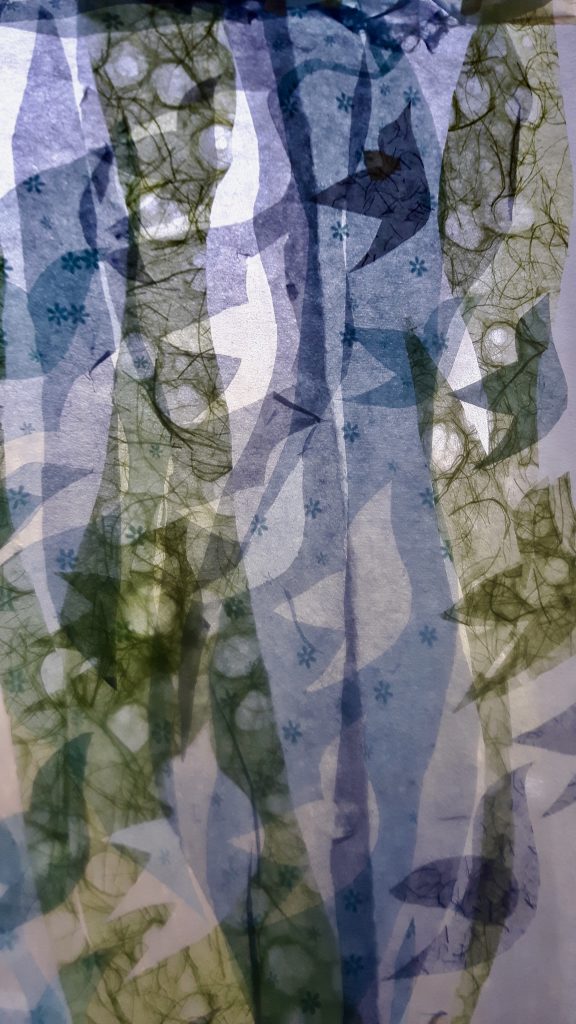
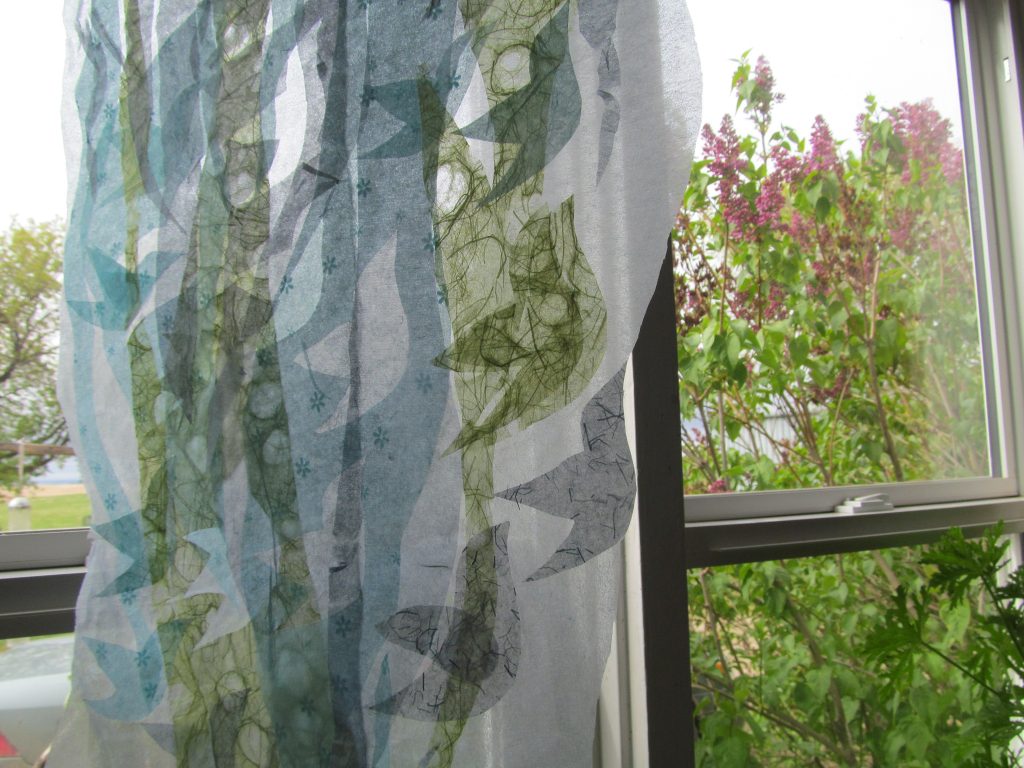
Sometimes a new piece of paper can suggest a new direction, or a new way of seeing things. Such is the case with a gift of the most delicate pale blue translucent paper my daughter Laurel brought me from Toronto. For a while I just admired it hanging in the window with other strips of translucent paper being hung over it for effect. Eventually, two new pieces took shape.

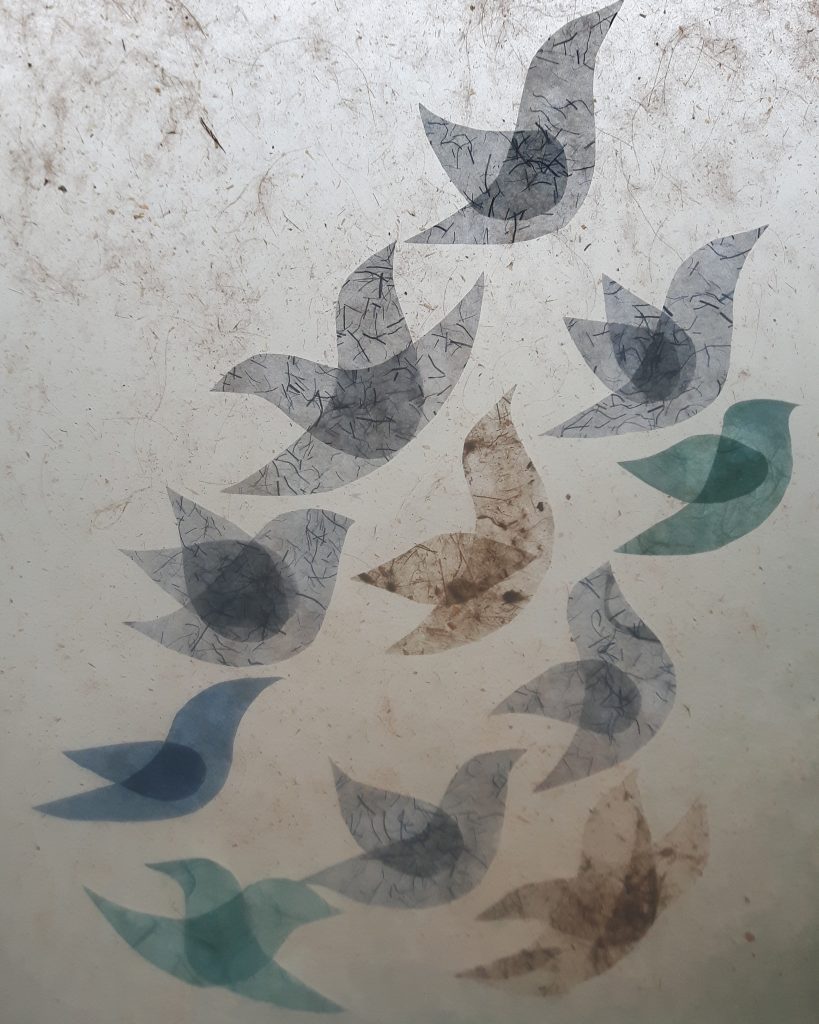
I love flocks of rice paper birds. Playing with such sheer papers encouraged me to focus more on the abstract shapes of birds and the spaces between them (and less on the individual birds).

The birds don’t alter space.
They reveal it. The sky
never fills with any
leftover flying. They leave
nothing to trace. It is our own
astonishment collects
in chill air. Be glad

(Li-Young Lee ‘Praise Them’)

The post Rice Paper Birds appeared first on Poached Egg Woman.

Remembering Our Book Fairy

$
0
0

Flying from East to West is our Book Fairy, but the truth is, she really didn’t look quite like this. And the other truth is, she began by travelling from West to East.

Our Book Fairy’s real name was Barbara. She was born in Kelliher, Saskatchewan in 1919. She gradually began to move East, beginning with University of Manitoba in Winnipeg where she trained as an architect, and eventually settling in Manotick, Ontario where she designed her family’s beautiful home and practiced architecture. I had the great fortune to grow up a few houses down the river from her. Once grown, I travelled from East to West where I eventually married and raised a family just 80 kms away from her birth place in Kelliher. For over two decades, our Book Fairy and her husband Doug sent parcels of books to our four daughters from East to West three times a year – every Hallowe’en, Easter and Christmas. Sometimes they even came to visit. Almost every second year, we packed into the family van, heading in the opposite direction with tents and sleeping bags, books and swimsuits, and great excitement to visit the Book Fairies. The collage above remembers Barbara the Book Fairy, who died this past February after 97 rich and marvellous years, many in the lovely home she designed. Here are some additional memories.

Barbara the Book Fairy was not a lone operator. Her husband, Douglas, is pictured flying a small plane on the right, in honour of his time as a navigator in WW2. He did not like to be called a “Book Fairy” but he was fully involved in sharing a love for books with our daughters. Our various thank you letters were addressed to “the Book Fairies,” “the Book Fairy and Hus(band),” and “the Book Fairy and Navigator.” Just below the plane is a parcel reminiscent of the many, many parcels we received over the years.

Look below the flying frog and see the four girls eagerly awaiting the parcel of books falling from the sky. There was such tremendous excitement in our home when a parcel from the Book Fairies arrived. It was an “Occasion.”  I used this opportunity to bribe my children – the Book Fairy’s parcel could not be opened until the living room was perfectly clean. Everybody had to be present. In each parcel there were specially picked books ( books about Egypt or Russia, books by favourite authors, books that were a complete surprise, books from their personal collection), an individual card for each girl, and candies or chocolates as befit the season.


Visiting them at their home in Manotick was another wonderful treat. Their home was filled  with beautiful objects and art, including a large statue of the Buddha in their basement. We enjoyed a tour of Mr. Humphrey’s garden followed by tea or ginger ale. Lunch out at a restaurant followed by shopping at Chapters was greatly anticipated by our daughters. On one such expedition, one of my children timidly asked if it was possible to have dessert. I was appalled at such cheek and immediately said no, but Mr. Humphreys interjected. “Absolutely! You can have any dessert on the menu.” (Note the large piece of cake with a cherry on top in the collage.) Shopping at Chapters was equally wonderful – the girls could select any book in the store. Imagine such a treat!

In later years, our lunches took place at Miller’s Oven in Manotick with mile high lemon meringue pie, and our book shopping happened at a used bookstore run by Watson’s Mill – both places very dear to our Book Fairy and her husband.

Seven years ago, when the Book Fairy and her husband turned 90, they travelled to Saskatchewan to attend Kelliher’s 100th birthday. I have many memories of that trip – amongst them, watching an endless parade of farm tractors and other vehicles on a day that was so hot “you could fry an egg on the sidewalk” – the only non-mechanical object in the parade was a Canada Post mailbox with two legs. The Book Fairies endured the parade and the heat with their usual grace and wry humour.

Barb and Doug had a special place in our home as Book Fairies, they were like parents and grandparents to many others as well. A love of books was central in our friendship, but they gave us much much more than books and chocolates and lunches out. They offered their genuine and keen interest in each girl. They offered glimpses into worlds far beyond the Saskatchewan prairies. They also loved and celebrated our farm world. They encouraged Shane and I as parents. They laughed at their foibles as they got older. They loved telling stories on themselves. They took such tremendous pleasure and delight in each other. Their many talents and accomplishments were only exceeded by their modesty. They made each of us feel special and interesting. They not only gave us a lifelong love of books and quest for knowledge, they brought magic and possibility and enchantment to our lives.

It is almost impossible to write about Barbara the Book Fairy without including the Book Fairy’s Husband because they were such a unit. The Book Fairy’s Husband, Doug, is still very much alive, and we will continue to share stories with him as well as enjoy his company.

To learn more about Barbara Humphrey’s contribution to architecture and heritage conservation in Canada, please read this tribute.


The post Remembering Our Book Fairy appeared first on Poached Egg Woman.


Art Buddies

$
0
0


When I was about 10, an uncle who was a  “Sunday artist” spent an afternoon  showing me how to draw cups and bowls. He taught me about volume and perspective, taught me how to shade with my pencil, and encouraged me to draw  with a “light touch.” He was patient and seemed to enjoy himself. I soaked up the attention. My aunts and uncles loved us all, but it was very rare for one of them to pay particular attention to one of us cousins. They were in their world and we were in ours. I now suspect that this uncle wasn’t so comfortable in the adult world, so for an afternoon, he crossed over.

When I was imagining “Explorations in Art” I wanted the young people who came to experience that kind of attention.  I have often worked with large groups of children and youth. Let the wild ruckus begin! Sometimes big group art experiences are more about handling materials and general chaos and completing a project  than learning about art.

My first ever Explorations in Art student was Lanelle. For the past two years Lanelle has come once a month, sometimes more and occasionally, less. Among her consuming passions are dragons, so we have learned a lot about art by exploring dragons. But we have also explored tractors, wildflowers, pencils, faces, cubes, cylinders, dogs, ski hills. Together with others we have explored art in the city, both in galleries but also in back alleys, restaurants and tattoo parlours. We have visited the horses, skated on the ice rink, climbed the hills and visited Grandmother Willow in all seasons. We play weird games in the car.  Lanelle has brought along her sister, her mom, her cousins and once, eight of her friends! We have favourite snacks – hot chocolate, ginger cookies, pizza. I have been promising her mango smoothies. She has promised me a fiddle concert under the willow tree.

One of the guiding principles of “Explorations in Art” is “Teaching is a two way path”. Nothing could be truer. I have a wonderful group of students and I do not doubt for a moment that they are among the very best  teachers I have ever had. They inspire me to see the world in new ways. Their interests take me in new directions. They shake me up.

While the one-on-one approach of “Explorations in Art” allows me to offer a student my full attention and tailor our time together according to their various interests, abilities and working rhythms, it also offers an unintended benefit – the very best art companions. It is about relationship as much as it is about art.

As such, the way Lanelle and I  create art together has changed. This summer we spent many happy hours creating in the same room…just enjoying the calm, creative, entirely enjoyable, and beautiful world we were inhabiting together. Lanelle is in charge of music – sometime roots music, sometimes calming music and sometimes dance music – for that, we have Marvin Gaye. Sometimes we have to shake it up and dance or do calisthenics. Sometimes we listen to a book. We have the same quirky (and sometimes dark) sense of humour. Sometimes Lanelle is absolutely quiet. She can be incredibly focussed. Sometimes she talks my ear off.

During the spring, we were having a wonderful talk and I had an epiphany. Lanelle is a kindred spirit. Friends for life, I am sure.  Renegades. Art buddies. So, this blog is for you Lanelle – with a thank you from the bottom of my heart. It’s also for my long ago (late) uncle who took the time. Another thank you.

(Question for Lanelle: How would you paint the bottom of a heart? Have you ever seen a person’s ear fall off because the other person was talking a lot?)

Lanelle’s most recent project, summer of 2017

Close up

We both love working on the floor. Keeps us down to earth (sort of).

Lanelle’s piece inspired this “Sprites Dancing in Full Moon” .We both love this lovely blue paper and I was inspired by the simple clean lines in Lanelle’s piece.

Lanelle’s first dragon with piles of gold coins plus some wonderful food, fall 2015

Sketching around the farmyard, spring 2016

Spring 2016

Collecting ticks and painting wildflowers, Spring 2016

Painting Pots PLAYshop, Spring 2016

Dominique and Lanelle, Art in the City, Summer 2016

Art in the City, Lanelle’s 7 minute sketch, summer 2016

Lanelle’s surprise Christmas gift for her family. A watercolour (framed by Lanelle) of her family skiing at Mission Ridge, fall 2016

Paper Playshop, Fall 2016

Lanelle’s friends, winter 2017

Self- Portrait #1

Watercolour, Winter 2017

Neve’s mermaid (Lanelle’s little sister) and Lanelle at work


The post Art Buddies appeared first on Poached Egg Woman.

Paper (S)mash eh? (Papier Mache Art Camp)

$
0
0

As some of you know, I have needed to stay off my right leg for some of the summer. I wasn’t quite sure how a papier mache overnight PLAYshop was going to go.

It went SMASHINGLY!

And for that, I have to thank Lilly, Kate, Kami Jo and Tania. I learned that it is possible to hold a PLAYshop while lying on the couch with your leg up most of time. I just ordered everyone around. When I stood up, they said, “sit DOWN.” And, I did!

Here are some photos from our fun time together – my thank you’s are at the end!

Lilly, pizza chef extraordinaire

Beginning to create our forms with balloons, gooey flour and water and newspaper

Let them dry…Off to the coulee! (Photo by Lilly)

Photo by Lilly

Blazing Star, Photo by Lilly

Pheasant Creek, Photo by Tania

at Grandfather rock, photo by Tania

Who is that under the umbrella? Why, it is Kate who is certain it will rain. It did not rain. But, there are bears and umbrellas are excellent bear protection.

The person with the wrinkles is driving the car

Hanging our forms out to dry (shouldn’t have got so enthusiastic with that glue but felt so good on our hands!!)

Kate hypnotizing a chicken

Tania bonding with a chicken

Supper. Who needs vegetables when you can have flowers and chocolate cake?

Stage 2, the balloon on the left will become a bowl and Kate with her collage

Day 2, Good Morning! (We did sleep in tents in between Day 1 and Day 2)


Art before breakfast (but not before coffee for the two adults)

Under the shade of Grandmother Willow, painting…letting the papier mache dry

Such smiles!

Our gallery or some of the pieces we did

Quiet time with Archie on the Sunshine Couch before finishing papier mache

Mama T and her bowl

Kate, amazing bangle maker

What better place to be than a farm???

We may look happy, but we are kaput, exhausted, done, finito…and happy!! As Lilly’s dad says, “All that arting wears a girl out.”

Thank you to Lilly for arriving first, rolling out pizza dough, building the fire, decorating the cake, serving me breakfast in bed, finishing your blue bunny (even though you were finished!)

Thank you to Kate for protecting us from bears (and rain), going to the coulee even though you hated it, enduring spiders, making me such beautiful bangles, cuddling with me.

Thank you to Kami Jo for building that fire, decorating that cake, delivering breakfast in bed, doing chores with a smile, driving the car (just kidding!!)and carrying stuff.

Thank you to Jessie, Marina and Handsome Stranger for giving Kate and Kami Jo a horse ride.Thank you to Shane for acting as if all this is just part of a normal day.

Thanks to the Nobles for letting us enjoy their land.

Thank you to Tania for being an adult and making the coffee (and so much more!) But, especially for being an adult.

The post Paper (S)mash eh? (Papier Mache Art Camp) appeared first on Poached Egg Woman.

Hand – Word Play

$
0
0

Hand (noun)
Old English hond, hand “the human hand;” also “side, part, direction” (in defining position, to either right or left); also “power, control, possession” (on the notion of the hand’s grip or hold), from Proto-Germanic *handuz (source also of Old Saxon, Old Frisian, Dutch, German hand, Old Norse hönd, Gothic handus), which is of uncertain origin

hand (verb.)c. 1400, “take charge of, seize,” from hand (n.). Earlier verbs were hend (Old English genehdan), handle. Meaning “to pass (something to someone)” is from 1640s. To hand it to (someone)“acknowledge someone’s ability or superiority” is slang from 1906, the it perhaps meant to suggest a trophy cup, award, etc. Related: Handedhanding.

Are you handy?

Are you a handful?

(I bet you’re HANDsome!)

Hands on. Hands off. HANDS UP! All hands on deck. Hands across the ocean. I want to hold your hand. Put your hand in the hand of the….I’ve got to hand it to you…on the one hand, on the other hand….first-hand, second hand. Living from hand-to-mouth, handmade. Let us walk hand in hand. Hand over hand. Sleight of hand.

Out of hand. In hand. At hand.

In good hands.

An old hand.

My hands are full. My hands are tied.

firm handshake. golden hand shake. limp handshake

high five!

handiwork

handicap

handyperson, handywoman, handyman

Clocks: the minute hand, the second hand, the hour hand

How many hands high is that horse?

Measurement: a handbreadth

A handle is held by a hand.

At hand.

By hand.

Off hand.

To have on hand.

Off one’s hands.

Underhanded.

Peekaboo.

Lay hands on someone.

Handhold

I wash my hands of this!

Handkerchief

Handicuff (put up yer dukes!)

You are a handful!

Expressions

To bite the hand that feeds you.

To know something firsthand.

I head that secondhand.

To force someone’s hands.

To gain the upper hand.

To get your hands dirty.

To give a hand.

To lend a hand. (Can someone borrow a hand? Would you ever get it back?)

To hand something down. A hand-me-down.

To give a hand up.

To hand something to someone on a platter.

To win hands down.

To be hands off. Or hands on.

To have blood on one’s hands.

To act with a heavy hand.

When the left hand does not know what the right hand is doing.

I know it like the back of my hand. (How well do you know the back of your hand?)

What we do with our hands

gesture, touch, clap, wring, hand-writing, stir, soothe, touch, caress, drive, drink, eat, paint, pat, tap, sign, stroke, slap (if we’re Batman), wash, handshake, scratch, reach, grab, carry, blow kisses, wave, hold….

If you are curious, check out these recent blog posts:  Shane’s Hands  about my husband Shane’s hands or Gestures which asks a question (or rather poet Mary Oliver poses a question)


(Source: https://www.etymonline.com/word/hand. I checked our dictionary at home which has several pages of words deriving from the root word “hand”)

The post Hand – Word Play appeared first on Poached Egg Woman.

Gestures

$
0
0

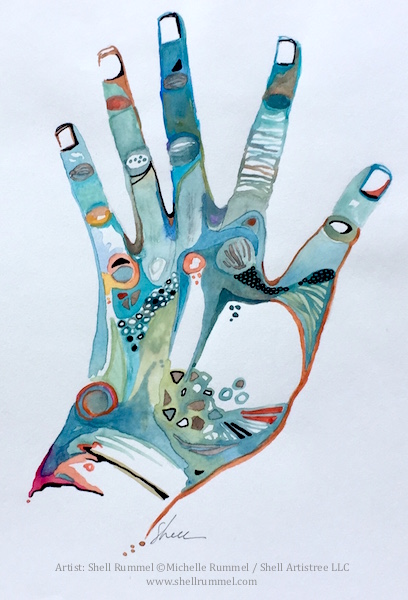
Permission to use this image “Give me your hand” granted by Shell Rummel ©Michelle Rummel/ Shell Artistree LLC. Other work by Shell Rummel can be seen at  www.shellrummel.com . 


“Of course! The path to heaven

doesn’t lie down in flat miles

It’s in the imagination

with which you perceive this world

and the gestures

with which you honour it”

–  an excerpt from “The Swan” by Mary Oliver from New and Selected Poems, Volume 1, Beacon Press 2005

How does your imagination perceive this world? What are the gestures with which you honour this beautiful place? These are some of the questions we will consider at Hands On! Celebrating our Hands

Other posts considering hands are Hand – Word Play about how we use the word hand and  Shane’s Hands  about my husband Shane’s hands.

With thanks to the imaginations and  expressions above of Shell Rummel and Mary Oliver.


The post Gestures appeared first on Poached Egg Woman.

Shane’s Hands

$
0
0

The photo above shows my husband Shane’s hands, and behind his hands, the new view that he wakes up to every morning. Shane is pursuing his dream of spending more time in the Yukon, and has taken a 6 month massage therapy stint to make this happen. He has been here 10 weeks, the longest period of time he has ever been away from his home at Kerry Farm in Saskatchewan. It is a rare person who who can say they still live in the house where they began their life!

When I first met Shane he was a grain farmer. He is a strong person, and certainly his hands told a tale of hard work and strength. Hands that worked with the earth, with seeds, with animals, with machines and engines…hands that often held the smell of diesel. A “get her done” mentality pervaded, so often he kept working even when his hands were tired, or chapped, or hurt, or sore.

His hands aren’t only strong, they are also deft. In his recent absence from our farm, we have had lots of small (and not so small) things go wrong, things that his hands know exactly how to fix, that our hands do not. Recently, none of us could remove a long  pipe attached to a float valve in our horse watering bowl, not only because we were not strong enough, but also because we did not know the precise feel of it.

When Shane began to think about  training to be a registered massage therapist, an old friend looked at him wryly and said, “Well, you better do something about those hands.” They had cuts and nicks, torn nails and cuticles. They were like rough sandpaper. They were “farmer’s hands”.

Going back to school at age 47 was no small feat. Making the transition from grain farmer to massage therapist is not a usual trajectory in career transitions. Shane remembers the first week, when the instructor gathered all of the (mostly female) students around a large garbage can to trim their nails. “If only the guys at the grain elevator could see me now!” he thought to himself.  The “rough sandpaper” aspect of Shane’s hands could be softened with cream on the hands, protected by gloves at night or while driving. Ironically, the final softening of his hands comes when he buffs his hands with fine sandpaper.

Strength and the ability to endure are definitely assets as a massage therapist. Shane has those qualities in spades.  But massage therapists also need their hands to “listen”, to hear the stories a body is telling, to be sensitive to the whole person they are massaging. As Raye Hendrickson, a Regina massage therapist writes, “In my massage practice, I consider my hands as another set of ears – they listen to people’s bodies and know, often before before my head does, what needs special attention.”  Shane became aware that some of his fellow students have the natural gift of “listening hands” that Raye describes. While he does not count himself among those with this natural talent, he is learning and he is listening and becoming more closely attuned with the subtle messages conveyed through our bodies.

Shifting how he works with his hands has opened up new worlds for Shane. As a grain farmer, he didn’t often listen to his hands if they were freezing or hurting because the priority was a job to be done. He continues to learn to listen to his own hands and to listen to the other signals his body is giving. He is less likely to push through. He has observed that some people who come for a therapeutic massage have pushed their bodies and not really listened to them until the pain is quite severe. 

As a massage therapist, he has been open to other healing modalities including reiki, Body Talk and healing touch.

Working with his hands as a massage therapist has opened up a special relationship with those who come to see him. He understands the power of touch and the power of presence in new ways. When his parents were aging and feeling various aches and pains, he was able  to offer them comfort and solace through the healing power of touch and massage. His parents most certainly soothed him with loving touch as an infant. The circle completes itself as he offers them comfort and love in their final years using his hands.

And, who knows? Would he have felt the pull of the Yukon if he had continued as grain farmer? Perhaps. Massage therapy has opened many new worlds for Shane. Using his hands as a massage therapist has provided him with a portable way of making of making a living and making a difference as he explores new places.

Shane enjoying Takhini Hot Springs on a frigid Yukon day, hands at rest!

This post has been written in the Yukon as I prepare for an upcoming PLAYshop called Hands On! Celebrating our Hands which will be held in Regina Sat. Feb. 10th, 2018 and in Fort Qu’Appelle Sat. Feb. 24th, 2018. Other posts about hands are Hand – Word Play and Gestures

The post Shane’s Hands appeared first on Poached Egg Woman.

Befriending Wildflowers (the quiet version)

$
0
0

“Nobody sees a flower – really – it is so small it takes time – we haven’t time – and to see takes time, like to have a friend takes time.” Georgia O’Keefe

“Befriending Wildflowers” was a two day art retreat which gave us time to “really see a flower” and to befriend some of the  wildflowers who live on the slopes of the Qu’Appelle Valley. By spending time with the wildflowers on the hills, by painting and drawing the flowers that called to us, we came to know a few flowers more intimately.

We were so fortunate to be able to hold this retreat at the Qu’Appelle House of Prayer  which is

Photo by Tania Wolk

nestled in the hills above Echo Lake. We painted under the shade of trees during the hot days, and hiked through woodland trails up to the top of the hills where grasses and flowers bloomed profusely in the early mornings and evenings. We were so warmly welcomed and cared for by Glenn, Margaret, Kathy and Tim.  Silence and quiet are encouraged and allow us to connect with nature more deeply than usual. For those who wished, Eucharist and “silent sitting” enriched our experience. The Qu’Appelle House of Prayer is a sacred place.

some of our “cat flowers”…instructor Kami Jo second from right

While the land (and the flowers) were our greatest teacher(s), we also learned so much from each other. Our youngest participant, Kami Jo, led a session on creating cat flowers which was fantastic. Tania helped us draw flowers in their simplest shapes, getting to the essence of the flower, and helping us see flowers in fresh ways. We painted with dominant hand, non-dominant hand, standing, sitting, upside down,  and we sometimes timed ourselves to get the feel of a flower rather than the details. We did flower yoga, and played flower charades, and  did breathing exercises. We laughed frequently. We moved  very slowly (to Kami Jo’s frustration). We called our unhurried pace “wildflower time”. We learned how painting on the ground in a meadow was a completely different experience from painting a vase of flowers.

Wildflower Joy! Photo by Tania Wolk

Photo by Elizabeth Gavin

Photo: Tania Wolk

Speaking for myself, It was pure joy to be with others who take notice and delight in wildflowers. Being with others  who are totally absorbed  in trying to get the feel of a particular flower on paper is very settling, calming and joyful. I saw wildflowers in new ways, and sometimes through the eyes of others, I saw familiar wildflowers in completely unfamiliar ways. I treasure my friendships with wildflowers – through the presence and teachings of my companions, my friendships continue to grow and thrive.

Once upon another PLAYshop, this one focusing on trees, hypnotizing chickens became the most fun thing to do. During our Befriending Flowers time, the most fun thing for Kami Jo was having the chance to drive Margaret in the golf cart! You have to scroll to the bottom for photos of that one.

I feel gratitude for the sacred place that is the Qu’Appelle House of Prayer, for the people that care for it, and for us; for the beautiful hills, grasses and wildflowers; and for each of those who took part so wholeheartedly!! Thank you.

Diane getting to know gaillardia

Gaillardia seed head, Diane

Gaillardia sun and shadows, Liz

Gaillardia, photo by Tania Wolk

Gaillardia Seed Heads by Tania

Purple Prairie clover, first impressions, Liz

Purple Prairie Clover, Photo by Tania Wolk

Cat flowers, Kami Jo

Purple Prairie Clover, Tania

Trying with marker, Kami Jo

Wild Rose, early morning meditation, Diane

Wild Rose, early morning meditation, Tania

Wild Rose, after the petals fall and before the rose hip forms. Beauty in every stage. Tania.

Liz’s flowers…gaillardia, bergamot, wild rose

Cat Flower, Liz

Wild Bergamot (using Tania’s shape method), Sue

Wild Bergamot makes us go wild and free, Diane

And the wind blew, and the bergamot got wilder!  Whoohee!!

Dancing in the Meadow, Sue

Kami Jo’s flowers, photo by Tania Wolk

Who painted the fastest of us all? (Kami Jo)

Early morning painting in the meadow

Totally absorbed as we “befriend a wildflower”

Mai Jo befriending Margaret, Margaret befriending Kami Jo. Margaret is one of the co-directors of the Qu’Appelle House of Prayer, along with Glenn Zimmer. Photo by Tania Wolk.

Saving the best for last!! Finally we are speeding up, says Kami Jo. Photo by Tania Wolk.

through the looking glass, Northern Bedstraw, photo by Tania Wolk


The post Befriending Wildflowers (the quiet version) appeared first on Poached Egg Woman.

Befriending Wildflowers (the noisier version)

$
0
0

It was a very hot and humid day when we set out to explore the wildflowers of Pheasant Creek Coulee, with small sketchbooks in hand.  Each sketchbook had several line drawings of flowers we hoped to find, with a space to name it ourselves, and a space for the common name. I had anticipated moving quickly across the pasture to the hills below but this gaggle of 5 girls and 2 moms stopped to look at  and appreciate every wildflower – they did not miss one – and gave each some very fun names. We collected a few to paint later and proceeded to a very steep hill full of western wild bergamots and a scary climb down  (for some!) that ended with a slide several feet down to the road!!

We returned to Kerry Farm a little overheated, but cooled down with a delicious potluck lunch. We found some shade to really look closely at our wildflowers and experiment with watercolour painting. Along the way, we visited Grandmother Willow (for a little tree climbing and some feather collecting) and said hi to the horses. We ended the day with some flower yoga and gymnastics as you can see.

This is a companion piece to Befriending Wildflowers (the Quiet Version)

The post Befriending Wildflowers (the noisier version) appeared first on Poached Egg Woman.


Ripple

$
0
0

In her book, Braiding Sweetgrass, Robin Wall Kimmerer writes, “In a way, I was raised by strawberries, fields of them.” She goes on to explain how wild strawberries gave her a sense of the world, and her place in it. She writes evocatively about picking and eating and celebrating with wild strawberries, and also about what the strawberries taught her.

We asked this question in the group of friends with whom I am reading and discussing Braiding Sweetgrass – what about the place you grew up in gave you your sense of the world and your place in it? It is a fine question and we answered with the first thing that came to our mind. It is hard question to answer, and as my first answer (birch trees) did not satisfy me, I continue to think about it.

I am at Christie Lake, one of the places I loved dearly as I was growing up. I return once a year if I can. Each time, I see aspects of the natural world here as if for the first time, or I remember something about the natural world that I thought I had long ago forgotten.

I love to get up early and come to the beach for a swim – usually before sunlight has fully crept into and transformed our bay.

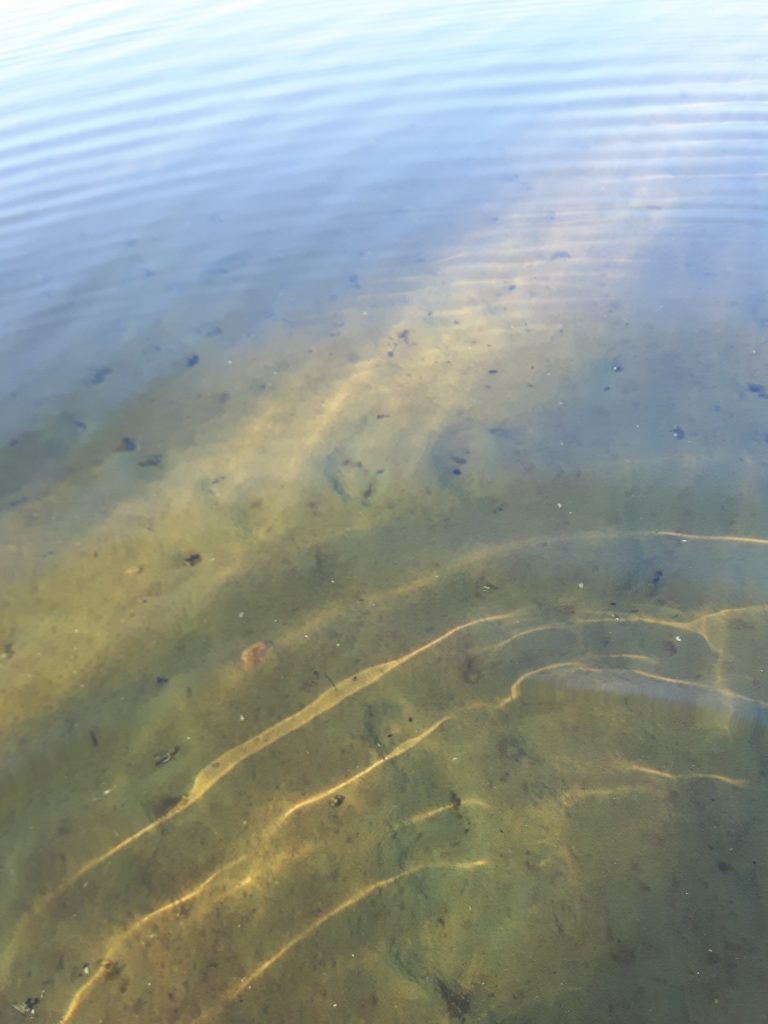
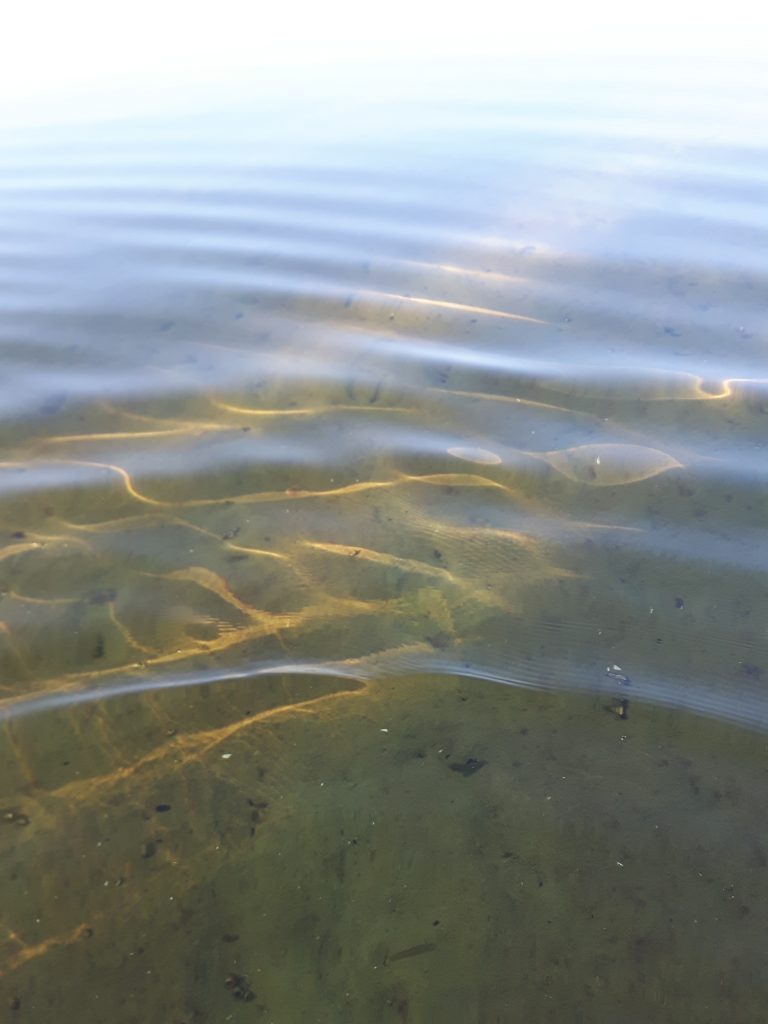
I could watch the play of light and shadow and wind on the water, the sand beneath the water, the reflections from the nearby trees and rocky shoreline for hours. I suspect that I spent many a dreamy moment as a child doing just that. In this dappled world, everything is shifting and changing every moment…it is all glimmers, possibilities, dance. The felt sense I get here belongs to this particular place, and no other place that I can think of.

I can’t come close to capturing this feeling with my Smartphone – which wants to focus in on one aspect of the scene in front of me and give it prominence. As soon as I step into the water to try to take a picture, I create ripples, changing the picture. Even if I could capture some sense of it visually, I would be missing the smell of the wind off the lake and decaying seaweed, the feel of wet sand under my toes, the songs of the birds, the waves lapping, the distant drone of a boat engine, the CheCheChee of the osprey, the feel of this air on my skin, the sound that this wind makes in these trees at this moment. I would be missing the constant movement and interplay of light, shadow, reflection.

The play of light and shadow and glimmer on the water did not raise me, but surely, it played a part in the raising of me, in giving me a sense of the world. and how I see and experience it.

The post Ripple appeared first on Poached Egg Woman.

Title? No title?

$
0
0

Title or no title? Sometimes, a title for a completed piece of art work pops into my mind, sticks, and voilà – I have a title. Sometimes, as in the piece above, no title comes.

i notice when visiting galleries, that i often look at the title of a work as a way of understanding it better. Perhaps the title offers a clue. Perhaps not.

What would you call this piece? What do you see? What feelings does this piece evoke in you? I would love to hear what your thoughts are, especially before you read on. You can contact me at sue@poachedeggwoman.ca if you have some ideas.

******************************************************************************

Here is a little bit about the making of this piece. After a busy fall, I started the New Year excited about creating art simply because I wanted to. My fall was happily busy working on a few commissions or creating pieces for classes I was taking or offering, but always creating for external reasons.

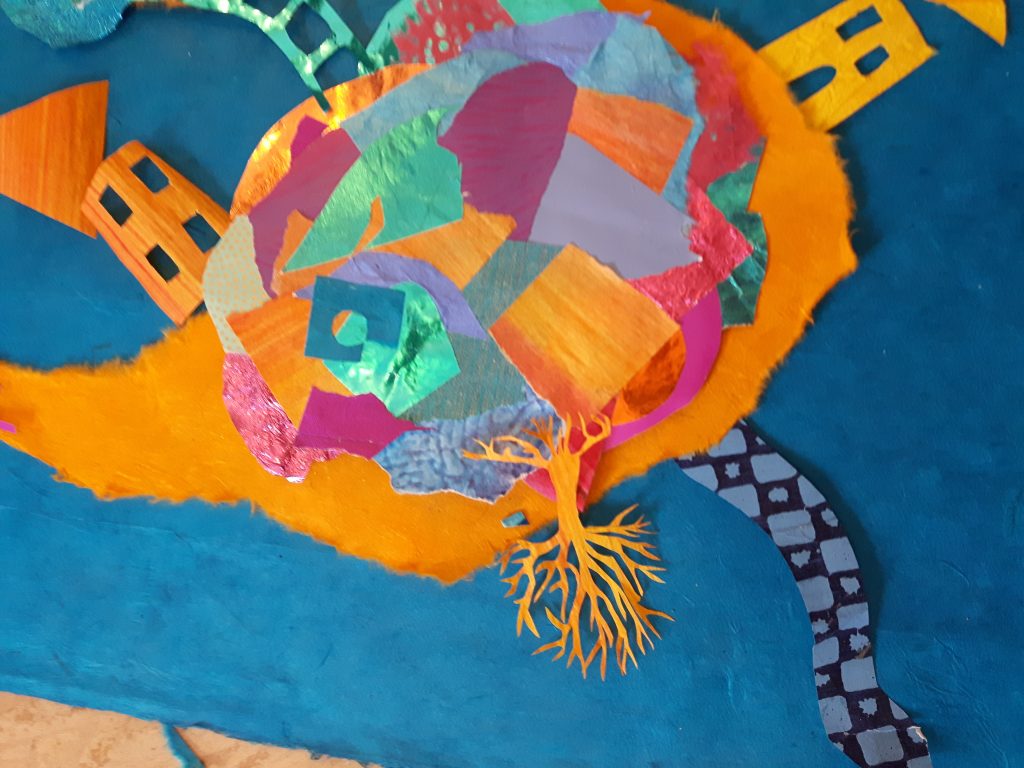
I began like I often do…by spreading out  large and small  paper pieces to see which colours grabbed me. First came the deep aquamarine or teal.

Then oranges, copper, turquoise, periwinkle, navy, fuschia, aqua, violet, yellow. Wheat paste scraps from Barbara, the deep  ultramarine a gift from Tania and Kami Jo, old shiny gift wrap, block printed scraps that have been my treasure for decades. Envelopes, shiny scraps, marbled paper. I played with these pieces of paper, tearing them, cutting them, arranging them this way and that. I glued two shapes together composed of pieces of these colours, but glued nothing down. Free floating shapes and scraps.  Pure pleasure.


The yellow wheat paste scraps suggested houses, so I thought, why not? I assembled all my scraps of paper on to different coloured backgrounds – orange, navy, teal.


Trying different backgrounds - orangeTrying different backgrounds - navyThe  two shapes consisting of torn scraps seemed to need orange backgrounds. The shapes seemed to me to be related is some way. They wanted to dance together. I had so much fun placing the shapes this way and that.  Using scraps of shiny paper, I made ladders. Using cut bits of dyed paper, I cut free floating steps in the air. Using my favourite block print scraps, I created curving and straight roads leading somewhere and leading nowhere. I felt the need for connections of one kind or another between the two shapes.

The world is reconfiguring. It has flown apart, with houses being upended and leaving earth. With new and surprising connections emerging.Collage before gluing down with a tree which was not used


I cut out trees, considered people, birds – none of them felt right. Somehow, stars did.final collage

The world is flying apart, and being reconfigured, and I feel full of hope. Too long for a title though!!

A week or so later, I read Shayla Wright’s post, entitled “The River Beneath the River”. Shayla Wright is a coach, spiritual mentor and facilitator based in Victoria, B.C. She posts “Lifeletters” on her website Wide Awake Heart which have nurtured and sustained me for the past year. In part of her post, Shayla beautifully articulates some of what I was feeling as I was rearranging colourful scraps of paper on an ultramarine background.

“It feels clear to me that we will not make our way through the mess we are in now, without our higher capacities. On a collective human level we are numb, fragmented, violent, and helpless. We have lost our way. Only a deep integration of our human and spiritual natures can help us face the enormous crisis that stands before us. Meditation is not going to do it. Activism is not going to do it. Our collective human evolution stands at a threshold. We have actually entered a liminal space, without a clear intention to do so. In the liminal space, we stand between the worlds. There is no solid ground. The liminal is the in-between space, the space where things pass away, the space into which new life emerges. We are standing there now, or perhaps, not standing. Maybe crawling, stumbling towards a future possibility we can barely see or hear. This future possibility is not only something we are moving towards-it is calling us. It has a magnetism. It is our strange attractor. It is asking us to become whole, to meet this moment with all of who we are. To embrace that which we have shut away. To step out of our bubbles, and travel into the unknown, the borderlands, the wild places inside us and out, what we have been avoiding.

The soul has a wild nature. It is not domesticated. It knows how to walk in the liminal space, where that which is known and familiar has fallen away. It sees in the darkness. It can hear whispers long forgotten, voices that are half formed, waiting for someone to listen and bring them into the light of day…”

Still, no title. But, it’s something to do with that liminal space, that Shayla Wright calls “in between space, the space where things pass away, the space into which new life emerges.” The colours and dance of the papers as I played with this piece spoke to me of not knowing, of confusion and uncertainty, of hope, of delight, of surprise, and wonder.


The post Title? No title? appeared first on Poached Egg Woman.

(What I Love About) Art in the City

$
0
0

“Art in the City” offers young people an opportunity to experience the city differently – looking for art in all the wrong places, or at least, in unexpected places, as well as looking at art where you would expect to find it – in art galleries.  Throughout the day, the art explorers interact with art they see,  by sketching, writing, and sharing their thoughts with others in the group about what piece they love best or which piece arouses their curiousity. Each stop is a surprise. With their eyes attuned to art, they see art everywhere – on the delicate hoar frost on winter trees, in a park bench, in the pattern on a rug. on the side of a truck.

Alley Art

More Alley Art, some spontaneous and some part of an Alley Art project

Looking at ourselves in a convex mirror in one of the Twin Towers, downtown Regina

Sketching near the warmth of Joe Fafard’s bull

enjoying our Ujrainian Co-op picnic inside the magical spaces of Spafford Books. No one wanted to leave! Ever.

The most beautiful thing at Spafford Books – Oxford, the Bookshop dog

More beauty at Spafford Books

Beauty tucked into every corner of Spafford Books

At the Assiniboia Gallery

Playing Fox and Geese at the Art Gallery of Regina (making a huge doily) in the snow

At the art Gallery of Regina, viewing “Tedium”…about doilies….dancing the doily dance

Every art day needs a napping place! So much beauty, so much to take in – here we are enjoying a calm moment with the kitties of Excalipurr Cat Cafe (with cat birthday cake to follow)

With thanks to the Ukraianian Co-op, Tania Wolk, Leah, Robin and Oxford at Spafford Books, the Assiniboia Art Gallery, the Art Gallery of Regina, and the Excalipurr Cat Cafe, and Vera Saltzman, intrepid research partner

To view another Art in the City blog, by the explorers themselves, see  Guest Blog: Art in the City

The post (What I Love About) Art in the City appeared first on Poached Egg Woman.

Spring is in the Air!!

$
0
0

Happy International Women’s day from the Kerry Farm Ice Rink, where spring is in the air.

How can I tell?

Ravens and magpies are more in evidence, swooping low. Dogs, young and old are chasing the ravens and magpies, even though we all know that dogs can’t fly.

The light is different. The March skies are starting to come.

I can skate and skate and skate until I am tired. Which is different from skating until I freeze!

The trails on our rink are sinuous and meandering, I love to follow their curves. I imagine I am a world famous speed skater (although Iin reality I skate quite slowly!) As I skate I think of the female leaders (from young to old) whose very integrity means they say what they have to say, quietly and succinctly. I am hungry for this kind of integrity in our public life. I think of all of the women in my life – my mother  and mother-in-law and grandmothers and aunts and sisters in law, my cousins, my daughters and their friends, my own friends – the women who have taught me about integrity and so much else. My skating weaves this way and that, giving thanks for all of these women, giving thanks for this day, this place, the very miracle of moving on a thin steel blade across ice.

Mia is digging….a snow sculptor

made in a cake pan, celebrating the last full moon

the layers on the inside of a snow drift

Last week, the North wind blew forming beautiful snowdrifts on the rink. Hello, Snowdrifts…this week I have been coming to know snow drifts, up close and personal. In clearing trails, I notice all of the layers of snow, some with grit in them, others pure white, some soft, some quite hard. Snowdrifts are best removed a layer at a time, and as I make a crack in the snow, the drift separates how it wants to…usually with lovely soft curves, just like the ice rink. Each piece of snowdrift is so beautiful. I place each one carefully along the sides of the paths. They look to me like a line of ancient women…standing in many different postures with the blue bowl of prairie sky as a backdrop. In the book I am reading, Braiding Sweetgrass,  Robin Wall Kimmerer describes learning how to basket weave. As she weaves, she feels as if she participates in “the beginning of a reweaving of the bond between the women and the land.” This is how I feel on the ice rink in a small way – working and playing with what nature gives us, what is already there to co-create something wonderful, and as I am doing it I am befriending  and getting to know the natural world better. In this, too, the women and the children will lead.

I give thanks.

The post Spring is in the Air!! appeared first on Poached Egg Woman.

Walk in Wonder

$
0
0

I check in with my smart phone at least a dozen times a day, often more. This is a relatively recent habit, as there were no smart phones before 2008. To check in with my phone requires energy and attention.

What if I checked in with Mother Earth as regularly as I check in with my phone? What if I directed my energy and my attention towards Mother Earth a dozen or so times a day? Would this make a difference? Would it make a difference to me? To the earth?

I decided to try and see for myself.

I began with something simple, something I already do. My morning walk. I started by pausing for a moment before setting off – to take note of what was all around me, to really feel the earth beneath my feet, to thank the earth for her many gifts. What if I took my first few steps with love – love and reverence directed towards the earth herself?

What if my walk was like a prayer for healing, for healing of the broken relationship between earth and us humans?

Walking this way has made a difference to me. This simple practice puts me in touch with the earth every day, deepening and strengthening my connection with her.

My whole walk isn’t this mindful – I also like to stretch my legs, walk quickly, daydream, walk backwards, sing while I walk, or just feel good about moving physically. But now and again throughout my walk, I stop – take pause, take note, remember who I am walking on, take one more step with love.

Spiritual leader Thich Naht Hahn (93 years young) practices walking meditation. He writes, “With each step the earth heals us, and with each step we heal the earth.” He recommends kissing the earth with the sole of your foot.

I can’t speak for Mother Earth, but I think walking in this way does make a difference to her. I believe the earth knows what kind of energy we direct towards her – whether it is distracted, hurried, reverent or loving. Whether we are taking from the earth with a spirit of reciprocity and thanks, or taking  from the earth with utter disregard. Right now, I believe the earth is hungry for our love – for footsteps and actions offered with attention, gratitude, and wonder.

Prayers for the earth. Prayers for ourselves. One step at a time.

“Family Walk Down our Road”, 11″ x14″. watercolour.


The post Walk in Wonder appeared first on Poached Egg Woman.

Viewing all 78 articles
Browse latest View live


<script src="https://jsc.adskeeper.com/r/s/rssing.com.1596347.js" async> </script>