Quantcast
Channel: Poached Egg Woman
Viewing all 78 articles
Browse latest View live

Farewell, Kerry Farm Ice Rink

$
0
0

It’s the beginning of March, and the feel of spring is in the air.

Secret Wish: I am holding out for a blizzard or two, as we need  more moisture in Southeastern Saskatchewan.

Just before we move into spring, I will share these photos of the grasses, leaves of Grandmother Willow and that noxious weed, Baby’s Breath, as they are found in around the Kerry Farm Ice Rink, and inside the ice of some lanterns (now melted). I love them all. I love how their forms are expressed in ice, that temporal art form.

Canary Reed Grass in ice lantern

Canary Reed Grass

Although canary reed grass is an invasive species, I love her form, especially in winter against the whites and blue and purple shades of the snow.

Willow leaves on ice


Willow leaves in ice. Lantern mold is an ice cream pail.

Willow leaves in ice lantern, bottom view

Grandmother willow

Baby’s Breath in ice and growing nearby in snow

The post Farewell, Kerry Farm Ice Rink appeared first on Poached Egg Woman.


Amaryllis

$
0
0


I have been enjoying reading accounts of people who have taken up a creative pursuit during the pandemic. In some cases, they are people in the latter half of their lives. I have particularly enjoyed watching some young people for whom creating art during the pandemic has been lifesaving and who are sharing their creations via social media. The time and space to create art has been one of the blessings of living in an otherwise limited world.

A dozen years ago, I enrolled in what is now called the Prairie Jubilee Experience. Back then it had a much longer title. My own desire at the time was to explore my spiritual life more intentionally and with some guidance along the way. This was exactly what I needed at the time. One of the unintended benefits of taking part in this two year course was that creative expression of all kinds was encouraged. We could write papers or we could hand in a painting (or a video of a dance). Throughout my life, I always found one way or another to express myself creatively, but this opportunity opened up new possibilities for me. Ultimately, I felt led to spend more and more time creating art, and to share my love of artistic expression and nature with others.

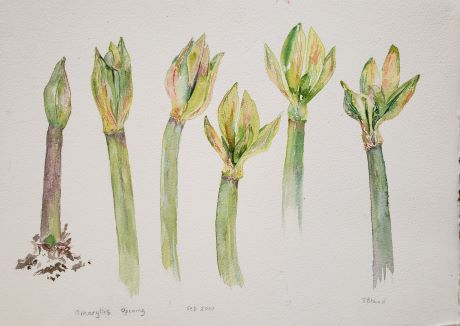
Once the course was done, however, I wasn’t quite sure how to move art into a more central place in my daily life. I could paint or create a collage in response to a spiritual question, but what would I paint without such a prompt? I decided to begin with what was right in front of me, to spend a little time each day painting the amaryllis that was growing in our window sill.

Here are some of those early watercolour sketches.

It was a great delight to observe subtle changes in the amaryllis each day. I didn’t know it then, but painting was one way to “befriend a flower”. The energy of the amaryllis astounded me. Each day, there was marked progress. All of this was happening at the same time as much inner growth was happening inside me. Then, one day, I had an epiphany. I thought I had chosen the amaryllis as my subject, but in fact, the amaryllis had chosen me. I felt there was an amaryllis inside me, reaching for the light and growing just like the one I was painting.

Since that epiphany, I have  learned that what I choose as subject matter is seldom random or arbitrary. Very often I am inspired by the very plant, or hill, or tree or colour that I need as teacher or medicine. I discover this as I paint or cut and glue papers to create an image.

Inside the Bloom, watercolour

“Inside the Bloom” framed…reflecting the outside world and in the very window the first amaryllis was in

another watercolour inspired by Amaryllis


The post Amaryllis appeared first on Poached Egg Woman.

Willow Dreaming

$
0
0

I began this cut paper collage piece a few springs ago, during a Tree PLAYshop held here at Kerry Farm. I finally returned to it this spring.

As I was cutting and gluing tiny willow leaves, I thought of all the different tree PLAYshops I have enjoyed through the years. Some have been wild and free (well, only one!) with the others being more contemplative. All have involved spending time in and amongst trees.  Most have involved creating an art piece. Each has celebrated the unique bonds between humans and trees.

The first tree PLAYshop had a curious origin. I was deeply disturbed by the bulldozing of an aspen bluff I had come to know well. Well enough to search for the yellow lady slippers that appeared beneath the aspen each spring, well enough to remember the doe and fawn I surprised one morning, well enough to remember the suspended moments a red tailed hawk and I were held each other’s gaze. I was so upset I phoned the landowner. He was respectful for the most part. At the end of the call, though, he said, “I think it’s good you got this off your chest.” Little does he know, but it’s been on and in my chest/heart ever since.

The destruction of those trees was the reason for the first tree PLAYshop. I mourned those lost trees actively but wondered if I appreciated the live trees in my midst as much as I might. I set out to actively cultivate more intentional friendships with trees, to learn more about them. If I could entice others to join me, we could have a tree PLAYshop. This continued exploration of trees has enlivened my world, affected reading choices, made me the happy recipient of articles, art, and books about trees, and allowed me to continue to exercise my tree climbing muscles. It has inspired me to create art about my relationship with trees. “Willow Dreaming” is the fifth tree inspired piece, and I will share the previous four at the bottom of this post.

I am a willow dreamer from way back. We had a stately weeping willow in our backyard by the Rideau River. I climbed her often, loving the seeming curtains of leaves and branches. A hide away. Once at the top, you could see for a long ways. This willow was the site of the Foxy Five’s Tree House. The Foxy Five was a club we girls made up when we were nine or ten. We enjoyed many adventures in the willow and beyond.

When I moved to Kerry Farm, there was a large willow by the dugout. She was a popular hangout for our daughters. They would canoe across the dug out with a picnic. They built a fort, hung a tire from a branch,  and had many adventures in this grand willow. I tried to stay clear as I recognized this tree as a “kid’s only” kind of place. Once the girls left home, however, I often visited the willow tree. Over the years and as I shared her with others, she became known as Grandmother Willow.

My children built a (very dangerous) perch on a branch hanging low over the water. During one tree PLAYshop, I watched a young girl nimbly climb to the end of the branch, and sit, precariously and happily, in this spot. My heart was in my throat the entire time, but I couldn’t resist spirit of the dare devil. Although the girl in my collage is quite safe in the tree, it was the dare devil girl who originally inspired this collage.

Lying comfortably on this willow, looking down at the water, completely at one with all of the elements, noticing the dance of ripples on the water, the movement of willow leaves all around, feeling absolutely safe and held is some of what I hoped to capture in this piece. I have a question: Does the willow dream of the girl? Or does the girl dream of the willow? Or, perhaps, both.

In the Hawthornes

Tree Hugger


Lost in a Book

“The Solace of Trees”, watercolour, 15″ x 15″

The tree PLayshop where “Willow Dreaming” started. With Danielle Stephens, Joan Tessier, and Wendy Paquin all celebrating trees


The post Willow Dreaming appeared first on Poached Egg Woman.

Prairie Landscape: A Commentary

Every Child

$
0
0

I often think about children in December. A lifetime ago, I worked at our community school. I remember the fraught, exciting, and sometimes magical time leading up to Christmas  as we tried to make the best possible memories for our kids. Being a parent is frequently overwhelming, and in the period before Christmas, the Overwhelm Factor looms LARGE. I recall the struggle of many parents, myself included, who could not afford many gifts, and the societal pressure to give more. And more.

Working every day with children, I sensed an acute longing that ran deep beneath seasonal shifts. What every child most needed was the truly attentive presence of at least one adult. “Don’t worry so much about all the gifts,” I wanted to say. “Spend time with your kids. Ordinary time, and special times, too.” Of course, often the advice we give, is the advice we ourselves need.  As a parent myself, I knew how hard  being truly present to my children could be. Some days,  I could hardly be present to myself! But there were moments…perhaps on a walk, or cuddled together reading a book. Baking together. Learning to skate together.  Stopping to watch a snowy owl on the way home. If December is about children, in our rush to “get it all done”, we often overlook the gift of simple (and not so simple) presence and attention that every child needs and longs for.

September 30, 2021

Continuing to think about children, I travel back in my mind to September 30th, 2021 – the first ever National Day for Truth and Reconciliation in Canada. A day set aside for survivors and intergenerational survivors of Indian Residential  Schools to ask Canadians  “to see us, to hear us and to believe us,” after unmarked graves were unearthed and confirmed at former residential schools across the land. As this day approaches, my husband and I are spending a few days along the shores of Lake Superior. I feel a heaviness welling up inside me as September 30th approaches. How will I mark this day? I  intended to be at home, joining a walk from the present Okanese School to the site of the former United Church run residential school, both on the same reserve. As we drive, we  listen to the stories of  survivors on the radio. I  think about the  people I know – family, friends, neighbours of all ages- who have been deeply affected by the legacy of these “schools”.

That evening, I collect random pebbles as I walk the beach.  Each is so beautiful and unique. Long smoothed by the motion of water over sand, they come in beautiful colours –  dusty rose, slate gray, white, ochre. I get an idea. I drop to my knees and smooth out a circle on the beach with the palm of my hand. Smoothing sand is soothing. Listening to the rhythmic sound of the waves rolling in calms me. I remember many contented moments as a child, doing just this, smoothing sand and arranging pebbles. Absorbed.

I collect more pebbles. I choose slate gray pebbles to spell  the word “EVERY” in capitals in the circle. Slate gray gives emphasis to this word. No child is left out.

For the word “child” , I use all the colours of pebbles spelled in lower case letters. Somehow, lower case letters seem vulnerable, like children are vulnerable. With each pebble I place, I think of a child I have known or who I know now. Some are thriving, others are getting along. Too many died way before their time from violence or suicide, drugs or a car accident.  A legacy not only of residential schools, but also our colonial and genocidal actions, past and present. I notice how the sand quickly covers some pebbles, rendering them almost invisible. I clean the sand off each pebble, so that each can be seen, can takes its proud place in forming this word.

The verb “MATTERS“, I spell out in capital letters in dusty rose – the colour of the heart. I think of the many ways we invisibilize children, especially those children who are not “easy”. I remember the times I have dismissed a child’s feelings. I consider how the unmarked graves are material (matter) evidence for something Indigenous people have always known.

Around the edge of the circle, I poke clusters of pine needles into the sand. The pine needles provide a border, some protection maybe, but what is inside the circle is now open to the air. All wounds need air in order to begin the process of healing. I find two wrapped orange lollipops which are from a feast I attended in honour of children who never made it home. These go on either side of the word “child” signifying the pleasures of childhood these lost children  missed.  Spelling these words, smoothing the sand, and thinking about so many friends and relatives allows the heaviness in me to shift a little. Creating this beach art feels exactly like a prayer.

Every Child Matters – Lake Superior, Sept. 30, 2021

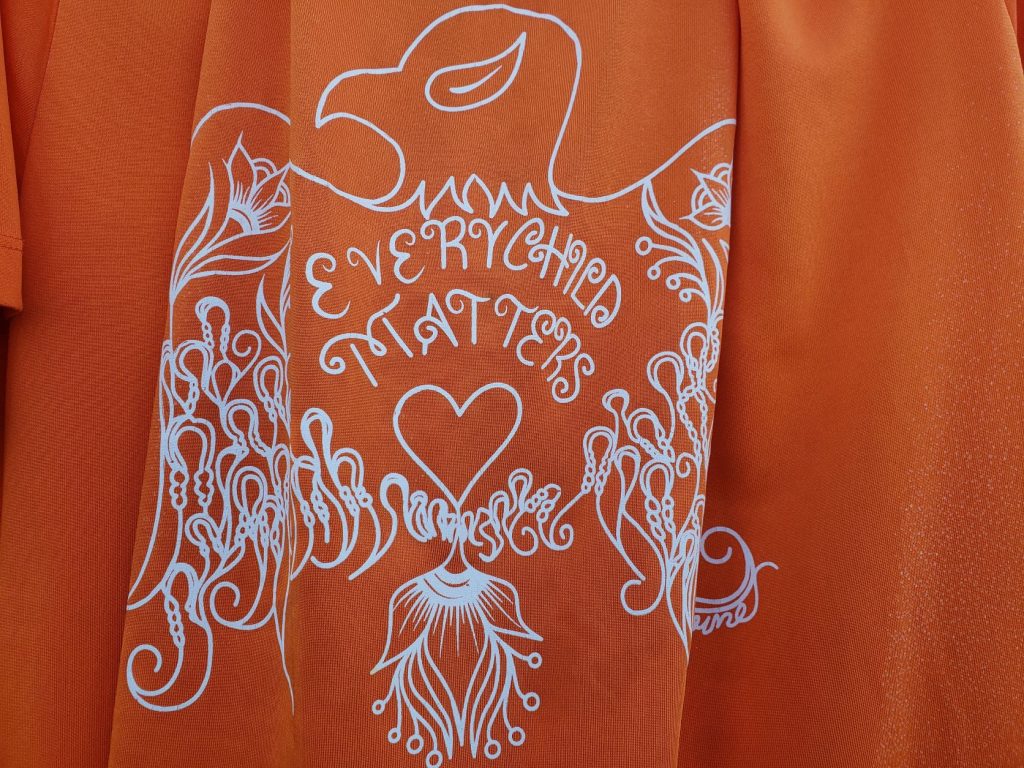
The Orange Shirt at the End of Our Lane – Every Child Matters

When we returned home, our daughters welcomed us with an orange shirt at the end of our lane. The orange shirt remains there. Each time I see it, I feel a slight jolt inside.  It has blown in the wind, fallen on the ground and been hung again. Each day it changes. I don’t want to get used to the orange shirt. I don’t want to forget.

The orange shirt reminds me….

EVERY      child     MATTERS                                                                                                                                                    Every child matters. See us, hear us, believe us. Truth before reconciliation.

Listen. Learn what I can. Unlearn what I grew up knowing. Learn about past injustices but learn also about present injustices. Learn from the brilliance and wisdom of Indigenous people. Listen.

I can offer my support in practical  and respectful ways as our neighbours and friends begin a ground search for lost children at the former Lebret Indian Residential School. Volunteers, food, money are needed.  I can also offer my prayers.

Back when I worked in the community school, we had pins that said  “It takes a village to raise a child.” So many wonderful people and creatures helped us raise our children. Can I be part of that village? Can I give back? Can I help lighten the load for other parents and grandparents?  I can try.

Every day the orange shirt reminds me that I need to live as if “every child matters”.              Every day, the orange shirt challenges me.

I am alert for the openings that help me truly live as if every child matters.

Every child matters … every day.

Orange Shirt Design by L. Delorme


The post Every Child appeared first on Poached Egg Woman.

Sparks from the Book Pile – Lyanda Lynn Haupt

$
0
0

A great pleasure this past winter holiday has been reading. Among my favourite books (ever) is Lyanda Lynn Haupt‘s book Rooted: Life at the Crossroads of Science, Nature and Spirit. 

There is so much wisdom, reverence and irreverence to ponder in this book, and yet, Haupt’s writing style has a sprightly quality that makes burrowing into this book pure pleasure. Reading Rooted reminds me of reading anything by Thich Naht Hahn – I feel different after reading. Tingly, lighter, spacious inside, quietly delighted. I also fervently wish every adult book was illustrated! Helen Nicholson’s illustrations  not only catch the spirit of the text, they amplify it. An example is the illustration below which accompanies the very funny and dear invocation to the book entitled “Frog Church”. The book is structured in chapters entitled “Listen”, “Wander”, “Alone” with an invitation at the end of the chapter, like “listen for the wild summons”, “walk a new way” and “sometimes, go alone.”

“Frog Church” – one of the many delightful illustrations by Helen Nicholson in Rooted. Used with kind permission of Helen Nicholson. Check out her work here.

My reading coincided with a twenty+ day break from social media, so I was especially open to Lyanda Lynn Haupt’s thoughts about distractions.

(Social media = distraction? Sometimes, yes! Or is it a tool, an essential part of my work and my social life? Both?)

Lyanda Lynn Haupt notes that common wisdom implies that we use only small portions of our brains, but that the research shows otherwise.  Our brains are “running at 95% of their potential most of the time”. During the 1990’s, neurologist Dr. Marcus Raichle studied different parts of our brains, and how each part is affected by certain tasks. What fascinated me about the results of his research is that “when external distractions are removed, certain parts of our brain are allowed to work at full capacity.” When we are not distracted, the areas that light up in the brain are

  • the recall of personal memories
  • emotional states and feelings, and
  • the evaluation of sensory input

All essential areas of the brain for any of us, and vital fodder for creativity.

Lyanda Lynn Haupt addresses the subject of  distraction in her chapter on solitude. While I am familiar with the rich and (sometimes challenging) benefits of an undistracted mind and heart during a period of solitude, I am more focused  right now on how surprisingly good it feels to be undistracted (if only for a time) from social media.

Without the distraction of social media, I notice that I feel more restful. Without the distraction of social media, I feel more spaciousness within.

I notice that the rhythm of my day changes. The second thing I used to do in the morning (after making coffee)  was check my social media, and if I was posting, I posted first thing in the morning. Depending on the posts, I checked regularly throughout the day to see what attention the post was getting (if any), and to respond. I definitely seek validation and approval on social media. I feel a compulsion to check social media, and what bothers me is that that is part of the big plan – the designers of Instagram and Facebook want me to feel this compulsion. I notice that my compulsion activates and speeds up my nervous system.

I notice that I hardly take photos when I am not engaged with social media. When I take photos, I take them with an eye to how they might look on Instagram or Facebook. (Note the set up photoat the top of this blog!!)

I try to take a break from social media regularly. I notice that I am never eager to return to this part of my life, even though I miss some aspects of it while away. So this particular time, I am returning but very minimally, and very slowly. I am taking my time.

Don’t get me wrong – there is lots I like about using social media. Yes, it absolutely helps my art business providing both contacts and validation for my offerings that I might not normally get. I also like the social aspects. I love the baby photos, the puns, the daily lives of families I would never otherwise see. I enjoy my friend’s art and poetry blog. I follow artists I might otherwise not know about. I love some of the political commentary. I have been introduced to so many wonderful books, ideas and podcasts. Occasionally a post makes me laugh out loud. What would I do without the Highway 10 Road Report? I can keep up to date with local happenings. And more.

Stepping away for a time, operating a little less from my own compulsions feels very, very good. I have just skimmed some articles on dopamine and the  instant gratification associated with social media use, but when it comes right down to it,  I  simply want the restfulness and the spaciousness I am enjoying now to last a little longer.  It seems to be just the medicine I need.

“No wonder solitude is so unnerving, powerful and essential,” writes Lyanda Lynn Haupt. I feel the same way about this break from social media.  She goes on to write that the break that solitude (or removing some distractions) “allows our brains to form interconnected neural root strands beyond those we typically utilize”.

I don’t know if my break from social media increased my enjoyment of Lyanda Lynn Haupt’s book Rooted or not. I am pretty sure I would have loved it either way. I read it slowly, with lots of breaks to stare out the window or take a walk. I wrote notes on it afterwards. I liked it so much, I am reading it a second time. Someday, I think I would like to own my own copy, and perhaps buy a copy for a friend or two.

“Sparks from the Book Pile” might become occasional series on my blog – something sparks my interest in a book I am reading, perhaps because it intersects with my everyday life. “Sparks from the Book Pile” allow me to share that with you. This is my first Spark.

The post Sparks from the Book Pile – Lyanda Lynn Haupt appeared first on Poached Egg Woman.

The Fairy Meets the Inner Critic

$
0
0

Fairy bodies come in all shapes, sizes and colours


I planned a paper fairy PLAYshop for January. Omicron came along and knocked that out of the realm of possibility – at least as a real LIVE breathing and in person PLAYshop. The Pandemic is giving our adaptability muscles new opportunities to flex!


Fairy paper packets


Instead I offered  an at home version where participants received a packet of papers to make their fairy, as well as access to instructions and templates and a short Zoom fairy consultation (really a fairy party) with me.

The night after mailing more than a dozen fairy paper parcels, I woke up from an unsettling dream. In the way of dreams, I can’t tell you anything about it, except that once awake,  this sentence popped into my head, clear as a bell. “Fairies are so insubstantial.”

“Insubstantial?!!” retorts the fairy. “That’s our superpower! Most beings are far too substantial! Insubstantial, yes! Insignificant, NEVER!!”

 I don’t think I laughed out loud then, but I have several times since. This first voice is clearly the voice of my own personal inner critic. She is not usually so funny!

Insubstantial. Flighty. Frivolous. Fanciful!! These are the kinds of words my inner critic loves to taunt me with.

One of the wise fairy makers said, ” I would just tell that inner critic to lighten up!!”

I notice that an enlivening spirit is with me when I am selecting fairy papers for people. I am happy as a clam, I love doing it, everything is a complete mess, and any notion of 1, 2, 3 or getting this done in a certain block of time is completely out of the question. Beside the point. It’s those darn fairies – trying to keep me messed up (in a good way)!

When creating a fairy, I am quietly delighted. Some parts of fairy making are quite finnicky and absorb all of my attention.  Time slips through my fingers.

Abra-cad-a-bra! People appear on the my screen. Pouffff – they are gone!! When gathering on Zoom, we fairy makers notice a companionable gaiety and levity in the air. We laugh a lot!

Collaborating with other fairy makers has stretched my ideas about fairies and the possibilities they hold. A mom and her two young sons adapted the PLAYshop to make superheroes, which got me wondering about male fairies and why fairies are so gendered. Another fairy maker started with the thought of creating “Dreaming Fairy” – the fairy who would contribute to the world we want to live into. During one Zoom fairy party, participants had songs pop into their minds when making fairies. “Rings on her fingers and bells on her toes”…and “Catch a falling star and put it in your pocket, save it for a rainy day.” The songs found their expressions on the fairies created.

“Heart of Gold” Fairy

 Sometimes I wonder, did I choose fairies as a project? Or, did the fairies choose me? I think the fairies chose me! In the midst of coldest winter, a pandemic that doesn’t seem to end, and a renovation job taking me deep into our stone basement to “mud” (reinforce the walls with a mixture of sand and lime), it seems that creating paper fairies is the perfect antidote, the best winter  and pandemic elixir, a panacea of sorts.

The fairies whisper “Tread lightly”! They loosen my laughter and delight and playfulness. They lead me down new flight paths.

Up, up and away!!

To view an ongoing gallery of fairies created, click here.

“Revolutionary Dancing Fairies are Getting Out of the Kitchen” – by Diane Mullan

“Petra (green fairy) is off her Rocker!” -by Diane Mullan

“Up, Up and Away!” by Diane Mullan


The post The Fairy Meets the Inner Critic appeared first on Poached Egg Woman.

Tuned In

$
0
0


Note: This post was originally written April 26, 2021, part of a collective response called Reading Robin’s Essay where contributors responded to portions of Robin Wall Kimmerer’s essay “The Serviceberry: An Economy of Abundance”. Spring 2021 was very dry, after a number of very dry years. 

Have you had the experience of wandering in a familiar place, and suddenly seeing another being as if for the first time?  Each time you go out, it’s as if you are drawn to this being? I liken it to being tuned in, on the same frequency as say, a white tailed deer. When I am tuned in like this, I see deer everywhere. I walk over a rise and there is a doe and we gaze at each other for a few timeless moments. I disturb a fawn hidden in a clump of trees. I find antler sheds everywhere. Sometimes, I am attuned in this way to a creature for a few seasons. At other times, I am drawn to a particular plant. Last spring, the willows, and later, the pussy willows, had me in their thrall. I visited them every day, photographed them, spent hours exploring their startling spring hues with water colour paints. These last few seasons, I am drawn to water. To the places that once held water and do not any longer, to the places that still hold water. I am drawn to the ways that water moves, the ways that it stays still.

This began last fall. I love walking the fields after harvest, taking note of their swells and hollows, their dips and rises. Almost without knowing it, I found myself walking a low channel that led to a large shallow depression in the land, both dry. For most of the springs I have lived here, these places are full of water, attracting thousands of snow geese, ducks, and, sometimes tundra swans during early spring, and shorebirds as the water recedes. We have had a series of dry years, so these low spots now hold the memory of water, the echoes of those rowdy geese. As I walked, I imagined these places full of water, as they once were. As I walked, I realized that my walk was a kind of prayer for the return of these waters.

Not so long ago, I went to Pheasant Creek after listening to Pat McCabe, a Diné (Navajo) mother, grandmother, activist, artist, writer, and ceremonial leader, speak about engaging with water. I had watched the creek’s spring flow ebb in a few short days. Now, the creek had become a series of ponds with dry land between each pond. Our land is thirsty.  My intent was to offer prayers. While sitting with the creek, I had a strong sense that I needed bring a bottle of water each time I visited, and to present it to the creek and the surrounding hills as an offering. Such a simple request. A new practice for me.

Now each time I go wandering, I pack a jar of water in my knapsack. Sometimes I sit quietly on a favourite rock near a shallow, still pond. It may seem still, but that’s deceptive. Duck weed is starting to grow here and there. A water bug disturbs the smooth surface of the water. A light breeze ruffles the water, small ripples are created. Reflections shift with the ripples.

I walk along patches of dry creek bed. Pheasant Creek meanders, curving in a most satisfying way. I hop from rock to rock, observing the pattern of the rocks, how in previous years the water has arranged and rearranged them. The grasses, too, show the movement of the creek when it is flowing. There are tiny shells, also holding the memory of moving water.

I wonder – if I was a creek bed, what would it feel like to have rushing water move over top of me? Then in another season to be exposed to air, to wind, to rain, to snow? To feel the sharp hooves of deer, the soft pads of coyote, the rubber sole of human feet on my belly when I am accustomed to the feel of water? If I was water, what would it feel like to move over and around these rocks, to navigate each curve, to caress the creek bottom? Would I feel the difference between flowing the length of a creek and merging with another body of water, and not flowing – becoming a pool with land all around? Does the rock I sit on miss the feel of being submerged in water?

In light of the many serious issues facing water on our planet and right in my own back forty, it is tempting to wonder if making an offering to the water, or taking time simply to be with bodies of water (or with the land) can make any difference.

I think it can.

I like the question Barbara Barnett asked in her piece entitled, “Meeting my Judgement” +: “With what mindset and heartset do I come to the harvest?” I might ask “with what mindset and heartset do I visit the coulee, sit by the creek, wander the hollows in the fields?”

I was recently reminded that before I spend time with a body of water, a tree, or other being, I must first ask permission. Hello, may I sit here? May I listen? May I share with you?* The idea is that I might have an intuitive sense that at this time the rock I like to sit on would welcome my company, but at another time, maybe not. Asking rocks and trees and water for permission to spend time with them was certainly not a part of my upbringing! At the same time, as a child, water seemed to be not only amazingly alive, but also filled with magical properties! Like so many of us, my imagination has been reigned in by our Western consumer culture which does not see the water, the tree, or the creature as sentient and conscious with complex ways of knowing. But if I believe that the rock, the tree or the water are in some way aware of my presence, then it makes sense that I would extend the same courtesies I would to a human friend.

Can I slow myself down, still my hamster wheel mind, and approach the land with an open spirit? We can get so busy that we overlook the gifts around us and do not have enough open space within to really take them in. As Geneen Marie Haugen, writer and wilderness wanderer, writes, “So much clamours for our attention, such noise, constant seductions and distractions, from whatever is most valuable to us. It is challenging to pull way from the narratives that are being determined for us, and to engage instead, with the wild earth or the deep imagination.”

I remind myself what I understood so clearly as a child, to “go wandering as if there are listeners”. I like how nature writer Barry Lopez puts it, “One must wait for the moment when “the thing” – the hill, [the creek, the tree] – ceases to become a thing and knows that we are there.”

It isn’t only that the deer, the willow, and the water “know that we are there”, but also, according to my friend spasaqsit possesom (Ron), they are darn happy we are there, and that we are noticing, becoming tuned in. Finally, they say!! Our attentive presence matters. It is imperative. This is an integral part of reciprocity.

I understand that “it is all gift”. Water, and every other aspect of our life. When I make an offering of water, I acknowledge this. As Robin writes, “Conceiving of something as gift changes your relationship with it in a profound way, even though the physical make up of the “thing” has not changed. Gratitude is so much more than a polite thank you, it is the thread that connects us in a deep relationship…”

To spend time intentional time on the land, near water, or under the sky and to pay attention is a counter cultural act. To be with the natural world in this way disrupts the dominant Western narrative of the land that is so deeply ingrained in us, even if just for the hour or two that we are out there. In subtle but important ways, I gradually change my orientation to all that is. By “tuning in” to the natural world, I let go for a time of the frequencies that dominate so much of my life. When I can settle in to a place, begin to move with the rhythms of the land, wander and explore “as if there are listeners”, I begin to know my right place here on earth.

+ Barbara Barnett’s piece called “Meeting My Judgement” was a part of the collective response to Reading Robin’s Essay, which was shared with other participants. 

*Thanks to those who took part in Brooke Arnold-Roche’s “Emerging into Spring” (https://fireandhoney.ca/) for “reminding” me and furthering many of my thoughts.


The post Tuned In appeared first on Poached Egg Woman.


Protected:

Dear Fort Times

$
0
0

Post by Sue Bland, Kate Hersberger, Marsha Cannon, Jill Whiting and Vera Saltzman

On June 27, 2022 the Fort Qu’Appelle  Times chose to publish an op-ed by Brian Geisbrecht called  “We have nothing to be ashamed of on Canada Day.” There has been a strong reaction to this op-ed  in the community surrounding the Fort, and numerous people sent letters to the publisher or the editor to protest their decision to publish this piece. Because some of us do not subscribe to or buy the Fort Times, here are a few of the letters that were written to the paper. If you have written a  letter and would like it to be included here, please be in touch with Sue Bland. You can read the op-ed here.  And because words have their limitations, Kate and Marsha have also shared some art. Kate’s is at the end, and Marsha’s is throughout. Vera’s photographs are throughout the post.

Letter #5 by Vera Saltzman

Re: Op-Ed by Brian Geisbrecht entitled “We have nothing to be ashamed of on Canada Day”

 
Dear Fort Qu’Appelle Times,
The question of whether or not to, or how to, celebrate Canada Day is one many of us are grappling with as we learn and unlearn our country’s history. The article you printed was not helpful, but instead hurtful to so many in the community you serve, both Indigenous and non-Indigenous. It saddens me to hear stories of the negative impact this has had on reconciliation efforts where I live. So many are working quietly to build relationships and trust, but your decision, your loud clear voice, has turned back progress.
I want to live in a community and country I’m proud of. I’m not proud of our history.  I can’t change it. But I can learn about it, acknowledge the hurt caused and work to right the wrongs that are happening today – so I write this letter to add my voice to all the others who are so disappointed and angered by your actions. Printing this article was wrong.
Vera Saltzman

“Walking Together and Honouring our Children”, 2nd Annual Walkathon . July 1, 2022. Photo by Vera Saltzman.

Letter # 4 by Jill Whiting

Dear Fort Qu’Appelle Times,

I have decided to join the many who were disgusted by the article in last week’s paper!! Publishing this makes me question whether I will continue supporting your paper! You know this article will only communicate that our community is racist even though you have grabbed it from somewhere else [the author is from Winnipeg]!! You have a responsibility to communicate truths…where is the truth here? Yap, it’s an opinion piece but I think maybe you should read these before creating chaos and allowing this person to spread untruths!!

Hope with the many upset responses you will send out an apology to us all!

Shame!

Jill Whiting

Art by Marsha Schuld Cannon

Letters #3 by Marsha Cannon

To the Editor:

Regarding the opinion piece: “We have nothing to be ashamed of on Canada Day”

I feel compelled to reach out and express my utter dismay and disgust that the Fort Times editorial staff allowed this garbage to be printed. Particularly in a town made up of a large percentage of Indigenous peoples.  Is this the opinion of the editorial staff? If so, I suggest you spend some time and energy speaking with the people in your community that have suffered for generations under unequal, unkind and racist policies.  This is not journalism or dialogue, this is hatred and dismissal by an individual who clearly does not care to learn.  I am appalled that you allowed this to be printed and that as Editor, you did not at the very least speak out against it or add a line that this is not the opinion of the Publisher.  These omissions become tacit agreement of these statements. Failure to call out prejudice is to add to it.

Shame on you.

Marsha Cannon


To the Publisher:

Regarding: opinion piece titled “We have no reason to be ashamed on Canada Day”

I am utterly disgusted and appalled to see such an opinion piece published in Saskatchewan – particularly in a town with a large population of Indigenous Peoples.  In 2022 there is no room for such blatant racist misinformation.  It is particularly egregious that the editor and publisher chose not to distance themselves from this by at least stating this is not the opinion of the publisher.  By not calling out the obvious bias and misinformation in this horrid piece, you become complicit in generations of uncalled for and unkind racism. I am not an Indigenous person and am horrified by reading this piece.  I can only imagine the effect on individuals who have be subject to such abuses and lies for generations.

I strongly urge you to apologize to the people of Ft. Qu’appelle and perhaps to reassure them that you will be more vigilant in the future when presented with such filth and drivel.

Shame on you.

Marsha Cannon

Art by Marsha Schuld Cannon

Letter #2 from Kate Hersberger

Hello,

Your Fort Times publication included this article: “We have nothing to be ashamed of on Canada Day.” by Brian Geisbrecht. This should never have been accepted  or published. It is shamefully inaccurate, hateful and racist. An apology and a committment to no racist content as well as fact checking is in order here.

Saddened and disgusted,

Kate Hersberger

Scroll to end to view art and poem by Kate entitled “Orange Shirt Day.”

Chief Michael Starr and walkers at “Walking Together, Honouring our Children”, July1, 2022. Photo by Vera Saltzman.

 Letter #1  by Sue Bland

Re: Op-Ed by Brian Geisbrecht entitled “We have nothing to be ashamed of on Canada Day”

An opinion backed by incorrect information can do great harm. This op-ed perpetuates misinformation and untruths which are hurtful to many people in our community – Indigenous and non-Indigenous alike.

First, I want to address some of the inaccuracies. To begin, it’s important to note that the National Death Register has a lowball figure of 4,118 children who died while at residential school. This is a low estimate because only 20% of the pertinent records had been released by 2021.

Mr. Geisbrecht writes, “… the hysteria about the 215 graves is ill-founded because not a single body has been unearthed. Those graves turned out to be soil disturbances and nothing more.”

Geisbrecht’s statement that “no bodies have been unearthed” is misleading since he omits some facts. It is important to understand that ground penetrating radar can only detect anomalies. Until excavations or exhumations can take place, no bodies will be discovered or “unearthed.”

He also omits saying that in the majority of Residential School sites the excavation work has either not begun or has not been completed. Three of the five he references (Kamloops, Kuper Island, and Brantford) are still involved in ground penetrating radar searches and have not made decisions about whether to excavate or not. This is also the case for many searches taking place on Treaty 4 and Treaty 6 soil in Saskatchewan. The author is correct that no bodies were found after excavations were done at the Charles Camsell Hospital and Shubenacadie sites.

Once the ground penetrating searches are complete, each First Nation concerned must make the incredibly difficult decision about whether to exhume the graves or not, so that a forensic investigation can take place. Imagine having to make such a decision.

Mr. Geisbrecht characterizes the response to last year’s news of 215 potential graves as “unfounded hysteria”. This is deeply disrespectful not only to elders who are residential school survivors, but also their families and loved ones. In the responses of my friends in their 60s, 70s and 80s, I observe very heavy hearts filled with a grief they will never “get over ”, a reminder of their own stolen childhoods, and of those children who never returned home. Survivors and their families deserve our utmost respect, our heartfelt compassion, and our acknowledgement of their lived experience during this emotional time.

In choosing to publish this op-ed, the Fort Times continues to privilege the view of the colonizer. A summary of the rest of Mr. Geisbrecht piece could read like this: Therefore, story over. Most of it was made up. Canada is not genocidal. Sure, we have warts, but who doesn’t? The author does concede that “widespread prejudice and discrimination – particularly against Indigenous people – was indeed part of our history” but then, unbelievably, writes, “But, that has passed.” Really? He wants us to turn the channel when our work of reconciliation has just begun.

I believe in the saying, “Truth before reconciliation.” For too long, non-Indigenous people have shaped the narrative of Canada’s history.  In recent years, through the survivor’s stories at the TRC and many other ways, the truth is finally beginning to emerge.

The children who attended residential schools, those who survived and those who did not, had no voice. It is essential that Canadians listen to these voices now. For me, listening to the first hand accounts of residential school survivors has been life changing.  As a non-Indigenous Canadian, I have a great deal more listening to do. I must continue to unlearn some of what I was taught. Learning the truth is not just a matter of the mind, it is also a matter of learning this in my heart. This is hard yet necessary work.

While the Times publisher notes that “opinions do not reflect those of the publication itself”, he is also quoted as saying, “It was an opinion of someone who we felt readers were entitled to see.” In addition, “Grasslands News said it hoped the article would spark conversation around reconciliation.” (CTV News, July 5, 2022)

How can you create positive conversation around reconciliation by publishing a one-sided view, backed by erroneous statements, written in an inflammatory way, by a person who knows nothing about our community?

The Fort Times chose to do harm within their community.  As a community newspaper, serving Fort Qu’Appelle and surrounding areas, they could have worked to build trust and shown empathy by sharing truthful stories. In Treaty 4 Territory there are many incredible Indigenous people with expertise, lived experience, wisdom and teachings that would benefit us all.

One Indigenous commentator asked, “Is this how all the non-Indigenous people in the Fort area think?” There is no denying that some do, but I am willing to bet that many of us stand with and beside Indigenous friends and neighbours. Many are grateful to live in Canada, feel pride in our country in some ways AND continue to reflect and learn the very difficult truths about our past and present record. Others are not willing to celebrate Canada Day at all. It’s complex.

In the CTV interview cited above, Summer Stonechild says it well, “I don’t discredit our non-Indigenous community for wanting to celebrate, but there [also] needs to be reflection on the truth behind what Canada is.”

I join Summer Stonechild and others in asking the Fort Times to apologize for their ill-considered choice in publishing this op-ed.

Sue Bland

Sources:

Information about the progress at Kamloops, Kuper Island and Brantford are below.

[1] https://www.cbc.ca/news/canada/british-columbia/tk-eml%C3%BAps-kamloops-indian-residential-school-215-exhumations-1.6460796

[1] https://www.thestar.com/politics/2021/07/15/first-nation-still-investigating-former-residential-school-site-in-british-columbia.html

[1] https://www.cbc.ca/news/canada/hamilton/mohawk-institute-search-money-1.6325480

Art by Marsha Schuld Cannon

~~~~~~~~~~~~~~~~~~~~~~~~~~~~~~~~~~~~~~~~~~~~~~~~~~~~~~~~~~~~~~~~~~~~~~~~~~~~~~

Kate writes, “Sadly this piece was created in Sept 2013 as a response to news then about the children and families broken as a result of this part of Canada’s history. This piece was also reposted May 30 2021 after the news media outlets began reporting about the graves found in Kamloops. ” (the original post can be found here.)
Orange Shirt Day

At half mast today
for the children
and their families
who endured the war
waged on them.
Hold their spirit softly
and love them now.
The children
who could not choose
who were not fed
who could not speak
who were not safe


The post Dear Fort Times appeared first on Poached Egg Woman.

Stranded

$
0
0

We are traveling from our large and rambling farm home in Saskatchewan to stay in a tiny studio apartment in Saint John, New Brunswick for a few months. Just getting out the door to leave on a trip is incredibly difficult for me. Even with lots of practice, I don’t seem to get better at readying myself to leave home. I imagine all the things that could go wrong!!

Once in the car, and on my way, everything changes. I am glad to be on the road. Worries fly out the back window as home recedes in the distance.

It’s a perilous traveling season – late March and early April. We can expect any kind of weather. And we get just about every kind of weather, starting with a blizzard blowing into Northwestern Ontario. Roads will likely be closed, even for a few days. A few hours later, we  found ourselves stranded in Dryden, Ontario.

With a warm motel room to nest in,  I  instantly I remembered how much I have enjoyed being stranded in the past. A few days to allow our spirits catch up to our bodies!

We can curl up under the sheets and dive into a novel, vaguely aware of  the steady rhythm of semi trucks passing by through the blowing snow on the #1. Until even the semis stop because the highway is now officially CLOSED. We are in limbo, safe in a cocoon of sorts. Limbo is a delicious place to be.

Shane tucked in at the inviting and warm Dryden Public Library

When we tire of cocooning, we can walk anywhere in Dryden, as long as we can get through the thick drifts of snow. Off to the library – a  welcoming  and light-filled space where we  spend a few hours and get a feel for this community. We explore Main Street, cross a bridge which goes over the many rail lines that run through Dryden, and cross the Sky Walk which goes over and rail and the Trans Canada Highway. We cross another bridge over the Wabigoon River which powers the towering pulp and paper mills. The river, the rail line, the Trans Canada – the arteries that connect this small city to the outside world. Shane and I like to search out the restaurant frequented by locals that is not a chain. We find the Patricia Inn Family Restaurant, clearly the spot to gather, and the food is savoury. We eavesdrop shamelessly.

The Dryden skywalk crossing the #1 highway and the rail lines


Art in the Dryden Skywalk


Art covering a now vacant building front

Next day, Shane goes off to check out the museum. I set off to find a community created mosaic, aptly called “Pieces of Dryden”. Tucked into a forest above the river, the mosaic is made up of thousands of pieces of dishes, ceramics, mirrors. wall and floor tiles and other fragments of glass donated by citizens of Dryden. Lead artist Willene Moffatt writes, ” The natural beauty of Dryden’s Northwestern Ontario surrounding area is expressed in the flowing and continuous lines that move around the entire structure. The basic elements of nature, earth, air, fire and water are represented in the total design.” The four surrounding benches are situated precisely in the four directions – North, South, East and West. A team of 15 artists and volunteers spent many hours creating the sculpture using 18,000 pieces.” I have passed this very place dozens of times driving from East to West but drove right on by – eyes on the next town, city, camp site. Now I know it is there.

“Pieces of Dryden” – community art 2010

Close ups of “Pieces of Dryden”


This respite has had the feel of a “snow day” – stolen time. The unexpected gift of not having things go according to plan slows us down. We have no choice – Mother Nature calls the shots. Every time! Besides, Northern Ontario, like the rest of us, has not had much snow. As we travel East, people celebrate the first real blizzard of the season and the much needed moisture it brings.


The post Stranded appeared first on Poached Egg Woman.

Letter from Saint John

$
0
0

How do you distinguish Saint John, New Brunswick from St. John’s, Newfoundland?

From a spelling point of view,  you don’t abbreviate Saint and there is no ‘s at the end of John.

We are in Saint John, New Brunswick and happy to be so!

Not only that, but we are in uptown Saint John, which would be downtown anywhere else. It is uptown, because when ships landed, sailors had to walk uphill to do what sailors do when they come ashore. It is uptown because we seem to always be walking up a hill!! Shane and I have been gently corrected several times when we say “downtown”. This distinction is important. It is something akin to spelling Abernethy (the village closest to our farm) – correctly. So many people naturally spell it Abernathy. You’ve got to get it right!!

We are here for two months. Imagine that!!? It couldn’t be more different from our usual surroundings at Kerry Farm on Stone Church Road back in Saskatchewan.

So many of the differences stem from the topography. Here in Saint John, craggy hills of rock (marble, shale, and sandstone) are delineated by bodies of waterthe Wolastoq (Saint John) and the Kennebecasis Rivers converge at Grand Bay. Then, this freshwater courses through the Reversing Falls where it joins the churning salt waters of the Bay of Fundy. Looking at the map below, we have walked many miles, mostly in the small yellow area – Uptown Saint John –  the city limits sprawl in all directions.

Not to scale! We spend most of our time in the yellow area labeled UPTOWN, but have walked to the West (pink) and North and bussed to the East. Small city really spread out. (I left out the cruise ships, but they land on the left side of Uptown, closer to the tip.)

Uptown, the streets are in a grid of sorts, but suddenly a street goes shooting off in a new direction or a street that was Market is now called King. The predictability I have come to expect from prairie towns and cities is not here. To say that I don’t quite have my bearings is an understatement!!

Our compact apartment is tucked in the basement of an old brick residence (c. 1850) smack in the middle of uptown. In such a rocky place, there are few basements. Our apartment feels like a cave to me, with just a thin slice of sky showing in the top part of the single window. At night the ceiling fan makes me think of the steering wheel on a ship. The sound of the herring gulls has me dreaming  of ocean voyages. I am grateful for this cave (or ship hold), a refuge of sorts, because every walk has me noticing something new. I come home from all this noticing and collapse on the bed! Naptime…again!

So much to notice!!

I can’t get over the strangeness and surprises of this very old city*. Part of it has to do with the historic buildings with ornate and whimsical trim, gargoyles and carvings. I am getting a crook in my neck from looking up so much.

Here are some of the surprises:

Surprise: I notice  the height of the doors! Much of uptown was built after the Great Fire of 1877, and everywhere I look the doors are gorgeous and built for a much taller variety of human than we see today. Why were doors of yore so tall, I wonder? They are tall in both humble abodes and grand residences. Tall and strikingly beautiful!!


I spoke with a life long Saint John person. Each week, she picks a different architectural feature to study on her dog walks – mailboxes, door knobs, windows, trim, entry ways, fire escapes, window brackets, front steps. Just in the short time we have been here, I feel like I am learning a new visual language.

Surprise: walking along an ordinary street and –  whoah! what is that? It’s the sea, right down there at the bottom of the street! Not exactly the sea, but the Bay of Fundy – sea to this landlubber for sure. Because Uptown is a hill,  I am surprised several times in one walk by the blue water at the end of  a road! It gets me – every time!!

Strangeness: Because of the hilliness and the rocks a building can be three stories on one street and five stories high on the next. Although, there are many examples of this, the historical photo below shows it so clearly that I could  not resist including it.

Custom House, 1881 – 3 stories on Prince William Street and 5 stories below on Water Street. Shane’s grandmother, Jean Hammond, arrived from Ireland here in 1911.

Surprise: Shane brought along his “slackline” – a kind of tightrope he can set up anywhere to practice his amazing balancing skills. It never occurred to this prairie born fella that there might be a city with almost no flat places! Ever-resourceful, here is Shane set up underneath the enormous Harbour Bridge. (The bike belongs to an onlooker.)

Strangeness: there are two large and ever present plumes of smoke in the sky from just about every vantage point in the city. These Irving owned pulp and paper mills take the raw products from the beautiful forests here and convert them into toilet paper  – Royale, to be exact. The two plumes of smoke send my thoughts in many directions. a. The imprint of the Irving family is everywhere in the industrial port city. b. How did we come to be a civilization that poured so much money and energy into making toilet paper  with a “velour softness for an elevated experience you’ve got to feel for yourself”?  c. Enough random thoughts, Sue. Just buy recycled toilet paper!

Surprise: The Saint John Free Library has the most beautiful  blue carpet, sweeping across a large space, with large windows looking out to the harbour. I love libraries anywhere but the spaciousness of this one loosens something wonderful in me. I spend many hours at these  windows observing activity in the harbour. Has a new container ship arrived? Where is it from? Can I watch it loading? What are in those containers? Can I watch the tugboats guide it in or out? Can I see a seal? Can I learn to tell the difference between types of gulls?

I can watch a container ship (or two) being loaded from the library windows

We walk miles, we observe and notice, and then we nap! And nap again. Lots of new neural pathways are forming in our stodgy old brains, I think! Our uphill muscles are growing stronger. The people here love their city, I notice a moistness comes to some eyes when talking about Saint John. Of course, they can tell you all the problems with their city but they are fiercely proud of this beautiful and gritty port with its many contrasts. As for us, we are thrilled to be getting to know this part  of the world a wee bit better, growing stronger calves all the while!!

  • Inhabited for millenia by the Wabanaki (specifically Maliseet and Mi’kmaq peoples), this place is known as Menahkwesk.  Later Called Saint John, it was the first city to be incorporated in Canada in 1785 when 15,000 Loyalists sought refuge here.


The post Letter from Saint John appeared first on Poached Egg Woman.

Because They Can’t

$
0
0

Please consider joining a vigil to honour and mourn those Palestinian children, students and teachers  killed by the active genocide in Gaza, as well as those who have no access to education this year. Details at the bottom of the post.

I feel excited for friends who are soon returning to school – one as a student teacher, another to a new school, some off to university, little ones starting out. I associate the excitement of a new school year with the lovely smell of pencil shavings, the feeling of a fresh start.  My heart also breaks for those  students, teachers, professors and educational staff killed in Gaza since October 7th as well as the 625,000 Palestinian students who have no access to school this fall. According to Unicef, over five hundred schools have been either been hit, damaged or destroyed by Israeli attacks.

When I saw that Women for Palestine (women._for._palestine on Instagram) were holding a vigil in Saint John to honour and mourn those students and teachers killed  in Gaza, I decided that I wanted to hold one too. But first, some backstory…

Some of you know that Shane and I lived in Saint John, N.B.  for 2 months this spring. Living in a city was new for us. Here in Saskatchewan, we live on a farm where a round trip to Regina takes two and a half hours.  In Saint John, I could walk a few blocks and take part in events organized by the local Palestine Solidarity group. These weekly marches nurtured me in so many ways.  While it seemed that much of the Western world wanted/wants to erase or invisiblize Palestine and Palestinians, the presence of Palestinians and others in uptown Saint John told another story. In casual conversations, I learned so much about people’s lives. I met first and second generation Palestinian Canadians, others from the Middle East and places all around the world. In the face of escalating horrors in Gaza and elsewhere, these gatherings offered companionship and solace. I found strength and hope in the unshakeable faith and conviction of my friends that, yes, Palestine will one day be free.

Among the beautiful and warm hearted people I met in Saint John are Mawadah and Rahma,  twin daughters of my  friend Lolwa.  Mawadah and Rahma  begin their first year of university at UNB – Saint John this fall.  Their brilliance, humour, and steadfastness absolutely inspire me. It is the group they co-founded, Women for Palestine, who is hosting the Not Back to School Vigil in Saint John.

Last May, Mawahda, Rahma, Lolwa and I spent an afternoon making paper birds at the UNB encampment. Those taking part wrote messages on the back of the birds in the language of their choice. The colourful birds flew in the trees a few days before  convocation. It was a memorable afternoon in the sun, sharing stories, laughter and outrage, working with our hands and standing up for what we believe in.

These new friendships continue to inspire me. They ignite my desire to learn as much as I can. Back now in Saskatchewan, getting to Palestine Solidarity events in Regina is often challenging. Sometimes I feel lonely for others who share my heartbreak, who are educating themselves, and who also believe it is important to keep talking about Palestine and to take action.

The opportunity to hold a vigil, alone or with others, together in spirit if not body, feels like the right thing to do. I am grateful to Women for Palestine for the idea. It heartens me to know that a few hours before we hold our vigil, they and others will be gathering far to the East of us for the same purpose. Please join us, in your own way.

We held two Not Back to School Vigil in Saskatchewan, on the evenings of Sunday, Sep.1 and Mon.Sep.2. The first overlooked where Katepwa Lake met the Qu’Appelle Valley, and on the next night we were on the shore of Echo Lake nestled in the Valley. Others held vigils at home.

Our vigils included a Nakota song, personal reflections, poems, a spontaneous playing of “Imagine” by John Lennon, a pan flute piece, silence, candles, being together while acknowledging our feelings which included – grief, heartbreak, a sense of helplessness, outrage, gratitude for this companionship and hope.

Resources for a Vigil

A vigil is a period of watchful attention, often spent in quiet contemplation, typically held as a form of commemoration or in anticipation of an event. It involves a collective or individual act of maintaining awareness, commonly observed during times of mourning, reflection, or preparation.

A good overall article (although 8 months old) about the effects of the genocide in Gaza titled “War’s Toll on Education” from the Guardian.

A more recent opinion piece “In Gaza, education is resistance.” from AlJazeera

The following paragraph comes from an open letter by Gaza academics and university administrators to the world, written in May 2024. “For Palestinians, education is a means of “sumud” (steadfastness); through education they can transfer their knowledge, memory, identity, history and values from generation to generation. Amid the destruction of education, Palestinian academics are calling for “the urgent need to reoperate Gaza’s education institutions, not merely to support current students, but to ensure the long term resilience and sustainability of our higher education system. Education is not just a means of imparting knowledge; it is a vital pillar of our existence and a beacon of hope for the Palestinian people”.”

Six hundred and twenty five thousand students cannot access education in Gaza. In Saskatchewan we have approximately 250, 000 students in public schools and post secondary institutions. The term “scholasticide” was coined by the Palestinian professor Karma Nabulsi after Israel’s assualt on the Gaza Strip in 2008/2009. In his research, Nabulsi has traced this colonial practice of targeting education back to 1948.

“When one of my Students Brings Up Palestine” a poem by by Faisal Mohyuddin. Touché.

A beautiful Palestinian tune played by my new Irish friends Ruth Smith and Fergal Scahill called Yumma Mweil-El-Hawa (Mother, the Sing of Love is my Song)

The wonderful website We are Not Numbers  includes includes first hand accounts from Palestinian youth. When I need a break from the headlines, I head here for a different kind of understanding. Hamza N. Ibrahim shares thoughts about the destruction of his university in “Dreams Deferred”.

The assassination of beloved professor, poet and activist Refaat Alareer on December 6, 2024 has sparked poems, songs and tributes such as this one “Remembering Refaat” by former student Alla Kassab.  Refaat Alareer’s lat poem has been widely shared since his death.

If I Must Die by Refaat Alareer

If I must die,

you must live

to tell my story

to sell my things

to buy a piece of cloth

and some strings,

(make it white with a long tail)

so that a child, somewhere in Gaza

while looking heaven in the eye

awaiting his dad who left in a blaze-

and bid no one farewell

not even to his flesh

not even to himself-

sees the kite, my kite you made, flying up above

and thinks for a moment an angel is there

bringing back love

If I must die

let it bring hope

let it be a tale

~~~~~~~~~~~~~~~~~~~~~~~~~~~~~~~~~~~~~

Finally, a poem that Tracy shared.

Summons

Last night I dreamed

ten thousand grandmothers

from the twelve hundred corners of the earth

walked out into the gap

one breath deep

between the bullet and the flesh

between the bomb and the family.

They told me we cannot wait for governments.

There are no peacekeepers boarding planes.

There are no leaders who dare to say

every life is precious, so it will have to be us.

They said we will cup our hands around each heart.

We will sing the earth’s song, the song of water,

a song so beautiful that vengeance will turn to weeping,

the mourners will embrace, and grief replace

every impulse toward harm.

Ten thousand is not enough, they said,

so, we have sent this dream, like a flock of doves

into the sleep of the world. Wake up. Put on your shoes.

You who are reading this, I am bringing bandages

and a bag of scented guavas from my trees. I think

I remember the tune. Meet me at the corner.

Let’s go.


By Aurora Levins Morales


The post Because They Can’t appeared first on Poached Egg Woman.

Nest

$
0
0

This January, I began to weave a nest in a hawthorn branch, using wool I have long cherished. As any self respecting bird will tell you, fingers are not the best tools for creating nests, especially when working with the unforgiving thorns of a hawthorn! I have many tiny hawthorn pricks on my fingers!

Each new year, I have the fun of  sharing a creative project with a group of friends. We meet over Zoom for three consecutive weeks. We have created paper fairies, imaginary homes and art maps to set our new year off to a good start. This year one of us had the great idea to create nests from whatever material we had on hand.

A nest seemed an apt project for these perilous times. A safe place of rest. A refuge in a world that seems to have gone mad!

Despite the prickle of the thorns, I became totally absorbed in weaving the nest. I eventually used a needle, which, after all, is something like a bird’s bill. The bottom of the nest is padded with soft silk, topped with downy feathers.

Sweet Dreams little Birdwoman

Why a hawthorn branch? In part because I feel a bit thorny. RRRRR-rrrrr. The news is making me thorny and cross. And, hawthorns are good for our hearts. My heart needs soothing. The thorns keep the nest safe from certain kinds of dangers.

The sky in my imagination has been filled with birds and birdwomen in flight these days. I loved sketching them – some  birds with women passengers and some birdwomen also! Out of this collection came the birdwoman who inhabits my nest.  In the photo below, you can see both the nesting version and the flying version of my birdwoman. Aren’t her cloud slippers to die for?

Here is what I imagine:

My birdwoman is taking care of an egg – a sky coloured egg  the size of a small chocolate Easter egg, but soft and smooth like an opal. She is keeping the egg safe and warm. Other birds and birdwomen, her friends, help her. They stay nearby, and all take turns sitting on the egg to keep it warm and safe. They tell each other hilarious stories and sing, sometimes lullabyes and other times sea shanties. They snack and are partial to chocolate fondue.

The egg  is where I ask myself: What matters most in these menacing times? What remains real and true?

Inside the egg are dreams, wisps of ideas, questions, colours, uncertainties,  loose strands and possibilities. The egg is a tender place.

Here are some wisps….

Humour and laughter.

Listening to the earth, staying close with the earth.

Compassion. Especially for those who fight to just survive day to day. That our compassion and our awareness changes the way we conduct ourselves day by day by day, even if incrementally.

Turning the news off for a few days.

Imagination.

A voice whispering: The land is waiting for those  who know how to watch and listen, for those who are open and know how to dream. Listen to the whispers of the land. Be silent for a while.+

Be silent for a while.

Keep your ear to the ground.

Enter fully the joy of making bread from scratch, the mixing by hand, the kneading, the washing of dishes in hot soapy water, the smell of the bread baking, the steam rising from the first cut.

Joyful resistance. Generous resistance. Dance and resist!!  Saying I refuse.

My friendship with you.

Cartwheels.

The times are urgent, let us slow down.^

How we do things is as important as what we do.~

Dream…

Notice that the hawthorn branch is shaped like a bird. Thank you, Marina, for noticing this over morning coffee!

 Thank you +Sharon Blackie, ^Bayo Akomaolafe, ~Leanne Betasamosake Simpson who expands the sentence above when she writes, “It became clear to me that how we live, how we organise, how we engage in the world – the process – not only frames the outcome, it is the transformation. The how changes us.”  from As We Have Always Done: Indigenous Freedom Through Radical Resistance, page 19


The post Nest appeared first on Poached Egg Woman.

Women of the World!

$
0
0

Flashback:  to 30 or so years to when I was raising 4 daughters here at Kerry Farm. I remember  just barely keeping my chin above the turbulent water that was carrying me along in those days. There was joy and heartache, exhaustion and elation, quiet moments and chaotic ones. There was so much of everything.  There certainly wasn’t a lot of time or space for reflection.

But,  certain memories from those early days as a mum stand out. This is one of them:

We had rallying cries, many of which made no sense at all. But, they cheered us and made us laugh. Our favourite rallying cry started with the lines “Women of the World….”

When someone began to chant these words, we would immediately leap onto the 5 chairs around our kitchen table, raise our fists in the air, and happily  and loudly yell, “Women of the World, Unite against the forces of OOOOOppression!!”  We loved drawing out the OOOOO in Oppression. Then we would laugh like lunatics. It was so much fun. Somehow, doing this together shifted whatever mood had been permeating the house. Our twins, Jessie and Marina, were probably about 4 years old when we started this craziness. Alice and Laurel would have been 9 and 10.  For me, the sheer ridiculousness and joy was an absolutely life saving intervention!

A year or two ago, we five women remembered our rallying cry once again. It makes us laugh every time!  We remembered because each daughter was in some way “uniting against the forces of oppression” – whether in the workplace, or society at  large. Each was speaking truth to power in her own beautiful and unique way.

Perhaps our hilarious rallying cry of yore had something to do with it!

*****

A few years ago, my friend Debra sent me  this poem by Indian poet Manju Kapur.  Here it is:  –

In my dream
women flew
larger than any
birds I have seen

They flew high
they flew together
over trees
and dry dusty land.

They came back,
some after years,
with water
careful in their beaks
for those who had
forgotten how to fly.

Manju Kapur

The poem inspired a series of 4 paintings – this one entitled “When Women were Birds”

Birds, especially birds in flocks, have captivated me since I was a girl. Even now, watching the pigeons as they change position in flight around our farm yard offers a distinct pleasure. The changing hieroglyphics of the snow geese migrations gives me a crook in my neck every time.  The birds I create  with paint or ink or lino or paper scraps are seldom real birds, more often imaginary and fanciful.

Rice Paper Birds in a Flock. To see more Rice paper birds, go here

“Transformation”. To see more of Poached Egg Woman, go here.

The kinship between women and birds delights me.  What about birdwomen – women who are part bird? Or birds who are part women?  Artistic renditions of hybrid creatures go back millenia. Even Poached Egg Woman can fly!! And she transforms while doing so!!

In these perilous times, the connection between ourselves and our winged relatives seems both vital and instructive. The ridiculousness of the birds and birdwomen and women above, their humour, their colour, their joy, their laughter, their unity and friendship amidst diversity are necessary antidotes to suppression of all kinds. They will not be suppressed! They represent the parts of us the colonizer can never touch.  Those qualities that cannot be taken away.  The very qualities we uphold and uplift in each other.

“Find the resistance, forge the resistance, lift up the resistance, shop the resistance, live the resistance, be the resistance.” writes Alex Neve. We write letters, we vote, we attend rallies, we participate in blockades, we pray, we learn  and unlearn what we can, we speak out in our circles, we meditate, we boycott and divest, we refuse, we reduce, reuse and save, we care with all our might for the vulnerable and those on the margins, we howl, we rest but we return, we are willing to be arrested if need be. All vital acts of resistance. They go hand in hand with creating art as resistance, laughing together as resistance,  and the small everyday acts of kindness and generosity that are our real currency. And sometimes, we even get up on chairs around our kitchen table and whoop out a rallying cry!!

I will finish with this lovely quote by Terry Tempest Williams:

“Once upon a time, when women were birds, there was the simple understanding that to sing at dawn and to sing at dusk was to heal the world through joy. The birds still remember what we have forgotten, that the world is meant to be celebrated.” 

Happy International Women’s Day!

In the ways that we can, let us rise up!


The post Women of the World! appeared first on Poached Egg Woman.


My Heart is Occupied

$
0
0

“It may seem like it’s someone else’s children [being killed] – but there is no such thing as  someone else’s children.”   Omar El Akkad

In early May, I was reading a news article about Gaza and I could barely continue to the end. The article contained some of what you see in this painting and more – including that people from Gaza would be sent to Libya*, the latest plan from the Americans who have bankrolled this genocide. I felt like I might explode.

So, I painted.

Partway through May, Canada, the UK and France issued a (relatively) strongly worded statement on the situation in Gaza and the West Bank. Finally – something that went beyond the protracted and continued silence from  G7 countries. I could feel my body relax a little, but not completely. It is one thing to say we will take further concrete actions, including targeted sanctions  – and another thing entirely to actually do it.

I feel grief at the horrific suffering of so many Palestinians. I feel another kind of grief about the silent  and not so silent complicity of so much of the world.

In Omar El Akkad’s remarkable book One Day Everyone Will Always Have Been Against This, he writes, “It is a disorienting thing to keep a leger of atrocity. Alongside the ledger of atrocity, I keep another.”  He lists a number of brave acts of resistance.

“Every small act of resistance trains the muscles used to do it. Even the smallest acts matter.  If we call for justice in one instance, we might do it again and again,” he writes.

Like Omar El Akkad, I keep a second ledger. Here are just a few of the people in my ledger whose actions lend me courage:

  • Sayd is about 8, a small boy who attends rallies in Regina with his family.  He is, without question,  the most passionate, the loudest yeller, the most impish and mischievous little protester around weaving in an out of the crowd, suddenly appearing right beside you with his twinkling eyes and wide smile.   Just thinking about Sayd makes me smile! Sayd brings to mind why we are out here – he keeps the children of Palestine front and centre as we bang our pots and pans a few days after food and medicine was blockaded. Sayd reminds me that “there is no such thing as someone else’s children.”

Jeff’s handmade sign, which kickstarted the UNB-SJ encampment, June 2024

  • When I was visiting Saint John last year, I met many incredible  people speaking out for Palestine, including Jeff Houlahan, a professor of biology at UNB-SJ who has since retired. What I remember about Jeff is that he was so distraught about Gaza, he painted this sign, and set up in a lawn chair outside his offices at UNB. And so began the UNB – Saint John encampment. Now,  Jeff is joining the Global March to Gaza  from Cairo to Rafa taking place in mid June. “Watching the kids protesting on campuses… was inspirational,” Houlahan says. “The courage and compassion those kids brought every day in the face of indifference left me ashamed to be sitting on the couch watching. It felt like my generation was leaving them to fight alone. Some day our children and grandchildren will ask us — what did we do when Israel was imposing a final solution on the Palestinians?” You can follow Jeff’s Journey here on Instagram by following @women._for._palestine
  • My friend Diane came to a quiet Sunday Art for Palestine when she couldn’t erase a photograph she had seen in the news from her mind’s eye. The photo was of male patients and medical staff at a hospital in Gaza, blindfolded, almost naked and standing in a line. She acknowledged this horror by painting it, making a sign that could be used by others in rallies. This coming together to share the ways our hearts break by creating art lifts my spirits.
  • I met my Irish friend, Ruth Smith at Kenosee Lake Kitchen Party where she taught violin and sang. An amazing person, Ruth is also a broadcaster, a bodyworker, a poet, a yoga teacher and retreat leader. Teaching yoga at Aida Refugee Camp in Bethlehem in spring 2023 opened Ruth’s eyes to what apartheid looks like in the West Bank.  Ruth is an active member of Pals for Palestine. Together with her husband, Fergall Schill, and Palestinian artists Mohammad Kahla and Abed Alqam, they recorded this beautiful song. Be sure to watch the video and listen right to the end when Ruth’s marvelous laugh will give a taste of her amazing vitality and enduring resistance. Follow Ruth on Instagram at @theruthsmith

I will stop here, but it is so heartening to realize how many people, how many anecdotes – both big and small – I could add to this list. Yelling with passion, banging pots, walking from Cairo to Gaza, singing your heart out, acknowledging the heartbreak, writing about it, creating art in response are all acts of resistance which in turn, encourage the rest of us.

My friend Carla gave me a felted heart she made. The heart was broken and partly mended. This gift touched something in me. I began a small series of tiny paintings –  about the condition of my heart. Below is Carla’s heart, and the hearts that have so far followed.

*Last mention of moving 1 million from Gaza to Libya was May 19, 2025.

Carla’s felted heart – in hawthornes, the tree that cures the heart

“Heart Weary”, Tea stains, watercolour, ink, 4″ x 5.5″

“Willow Heart”, Tea, watercolour, 3″ x 4″

“Heart in a Vise”, 4″ x 4″. “Heart in a Vase”. 2″ x 3″, Watercolour and Ink

“Heart Attack”, handmade rubber stamps, 4″ x 6″

“With Heavy Hearts”, tea, watercolour, ink, 3.5″ x 5″


The post My Heart is Occupied appeared first on Poached Egg Woman.

Dear Mark Carney, Gaza is Starving

$
0
0

Dear Prime Minister Carney,

As you know, as we all know – Gaza is starving.

I urge Canada to do everything possible to stop the atrocities of mass starvation, forced removal and genocide in Gaza and in the illegally settled West Bank. Because we as a nation signed the 1948 Genocide Convention and the 1998 Rome Statute establishing the International Criminal Court, we are required  do everything in our power to fulfill our international obligations.

I join many Canadians asking our government for decisive action now.

  • Work actively on an immediate and permanent ceasefire, and the release of all Israeli and Palestinian captives.
  • Insist on full humanitarian access to Gaza. Demand that the Israeli ban on UNWRA be completely lifted.
  • Publicly support the role of international courts, and fully comply in holding to account those who violate international law. Recently, at a UN Human Rights Council, 50 states released a joint statement in “which they firmly rejected attempts to undermine the judicial independence of the ICC and the integrity of the Rome Statute system” – a direct statement about the US sanctions on Francesca Albanese and other ICC staff by the US. Why did Canada not speak out with so many of our allies about this? In June of 2024 and February of 2025, Canada did speak out expressing our “unwavering support for the independence, impartiality and integrity of the ICC” during similar attacks on the ICC. What has changed?
  • Enforce a comprehensive two way arms embargo. I was shocked to learn that earlier in July Canada authorized 37.2M dollars in new military exports to Israel, backing away from its previous “pause” of all new permits.
  • Withdraw from the free trade agreement between Israel and Canada, initiate investigations under the Crimes Against Humanity and War Crimes Act, strip charitable status from Canadian organizations found to be complicit in crimes under international law. 
  • Immediately join the 149 states who recognize the State of Palestine, and support all efforts for Palestine to be admitted as a full member of the United Nations.

Further, I have grave concerns about Bill C2 (the Strong Borders Act), which has passed the first reading in Parliament. Break this omnibus bill up, so that it can be properly and thoroughly debated in Parliament. Over 300 human rights and refugee rights groups across Canada have spoken up unanimously in the their deep concern that Bill C2 is an attack on refugee rights to seek asylum in Canada. Seeking asylum is a human right. Amnesty International writes that “Bill C2 “is congruent with the Trump administration’s vicious assault on refugee and migrant rights and its efforts to paint newcomers in a negative light. Intentionally or not, Bill C2 paints people escaping persecution and violence with the same brush as serious public safety concerns such as the flow of illegal fentanyl or weapons.”

One of our duties under international law is to provide refuge in the face of  continuing genocide and the present calls from Israel /U.S.  to rid all of Gaza of Palestinians. Canadians showed incredible solidarity with Ukrainians when our temporary visa system enabled the arrival of almost 300,000 Ukrainians. In contrast, the “special measures” visa program created for Palestinians in Gaza who have family in Canada has not seen a single person evacuated by the Canadian government through this route, although small numbers of Gazans have made it here other ways. Over 7500 Gazans have applied to come. We have blamed this abject failure on the need for biometric ID checks that are functionally impossible in what remains of  Gaza today. Other countries including Spain, Italy, France and Australia have all found ways to act. This is beyond unacceptable.

As a Canadian, I crave principled and ethical leadership on the international stage. We must, as Canadians, do everything possible to speak out and take actions to stop genocide, war crimes and crimes against humanity, as well as  emphatically add our voice to strengthen the rule of law in this turbulent and violent world. If not now, when?

Sue Bland

To:

mark.carney@parl.gc.ca, Anita.Anand@parl.gc.ca

My MP – andrew.scheer@parl.gc.ca

Office of the Prime Minister, 80 Wellington Street Ottawa, ON K1A 0A2

Hon. Anita Anand, Foreign Affairs, 229 Wellington Street. Ottawa, Ontario, K1A 0A6

Andrew Scheer, House of Commons, Ottawa, Ontario, K1A 0A6

To read another related post, please check out https://poachedeggwoman.ca/my-heart-is-occupied/

“My Heart is Occupied” Watercolour, Ink, Pen, 8.5″ x 10.5″


The post Dear Mark Carney, Gaza is Starving appeared first on Poached Egg Woman.

Full Circle

$
0
0

“It may seem like it is someone else’s children (being killed) – but there is no such thing as someone else’s children.”  Omar El Akkad, One Day Everyone Will Have Always Been Against This

When I opened the surprise parcel, out tumbled a beautiful green and white keffiyeh* – a gift from my friend Emily, along with a letter sharing the story of why she was giving it to me.

Briefly, the story goes like this. Emily’s daughter and son-in-law were producers on a film you may have heard of – Sugar Cane – the award-winning documentary which investigates St. Joseph’s Mission in Williams Lake First Nation directed by Julian Brave NoiseCat and Emily Kassie.

When in Los Angeles for the launch of Sugar Cane, her son-in-law fell into conversation with a director from Palestine. I can only imagine them sharing the different versions of settler colonialism, occupation, and genocide practiced  in North America and in Palestine. The Palestinian film director gifted Emily’s son-in-law with the green and white keffiyeh. In time, he offered it to Emily’s husband John.

After a while, they felt the keffiyeh should move on and they gifted it to me. The keffiyeh arrived at the perfect time – I was feeling despair and helplessness as the ongoing genocide in Gaza and violence in the West Bank continued to worsen, and the world watched in silence. 

Emily sent information about Sugar Cane, which was about to be released. It showed at the Broadway Theatre in Saskatoon but I was unable to go. I knew it was streaming, and while I read reviews and listened to interviews, I never managed to see the film that first year.

Guess what came to my own community on September 30, 2025 (our National Day for Truth and Reconciliation)? You’ve got it – Sugarcane was showing at the gym at Wapiimoostoosis – the only remaining part of the residential school which operated in Lebret for over 115 years.  Members of Star Blanket Cree Nation and the surrounding communities gather each September 30th for a pipe ceremony, a smudge walk, to share stories from survivors and to enjoy a delicious lunch together.

Artist Chasity Starr, her “healing”  mural and her proud family looking on, back of gym at Wapiimoostoosis

Three generations – Chasity and her mural, her mum and her nephew, back of Gym at Wapiimoostoosis

This seemed exactly the right place and the right time to see Sugarcane. With a bag of warm popcorn, I watched Sugarcane on the big screen with my friends, my treaty relatives, and my neighbours.

Just two weeks previous, I was on Parliament Hill attending part of five day vigil called the March to Ottawa. The March to Ottawa honoured the 20,000+ children who have been murdered in Gaza by inviting people to read aloud their names over the course of the 5 days. The first reader was Anishinaabe elder Albert Dumont, former poet laureate of Ottawa, and member of the Kitigan Zibi Anishinabeg First Nation. His words, and the empty shoes, roller skates, sandals and boots that symbolized some of those lost lives reminded me of the shoe memorials  found          across Canada after 215 potential graves of children were discovered at Kamloops in 2021. In both cases, the shoes symbolize children’s lives tragically cut short through acts of genocide by the occupying power.

As well as reading the names of children over the five days, hundreds of Ottawan’s contributed a banner which stretched a city block where the name of murdered children were written in hand. Dozens held this banner aloft and in silence on the day I attended the March to Ottawa.

Opening Remarks, March to Ottawa, September 15, 2025

Shoes to honour the children who attended residential school across Canada and who never came home. Credit: Okotoks Online

Omar El Akkad’s words (quoted at the top) have been echoing in my heart this fall. In the dedication to his book, he quotes Polish poet and essayist Wislawa Sxymborska from her poem “Vietnam”. It’s worth sharing here:

“Woman, what’s your name?” “I don’t know.”
“How old are you? Where are you from?” “I don’t know.”
Why did you dig that burrow?” “I don’t know.”
“How long have you been hiding?” “I don’t know.”
“Why did you bite my finger?” “I don’t know.”
“Don’t you know that we won’t hurt you?” “I don’t know.”
“Whose side are you on?” “I don’t know.”
“This is war, you’ve got to choose.” “I don’t know.”
“Does your village still exist?” “I don’t know.”
“Are those your children?” “Yes.”
Polish; trans. Stanislaw Barnczak & Clare Cavanagh

“Are those your children? Yes.” Five words.

I highly recommend watching Sugarcane .  One reviewer writes,”  It’s a remarkably courageous and exposed work, particularly for co-director Julian Brave NoiseCat and his father, Ed Archie NoiseCat, whose painful journey together in search of healing is the film’s spine.” I was moved by the measured telling of this story. Incredible real-life investigator Charlene Belleau has imprinted her solid  determination, courage, and love on me for always. Her  steadfast commitment to finding out the truth about these children, and honouring them by doing so remind us indelibly that all of the children, every one,  are in our care.


*Keffiyehs were first used as a symbol of resistance, self-determination, justice and freedom during the Arab Revolt against British Colonial Rule during the 1930s. Often they are black and white. I love that mine is green and white symbolizing resurgence. I wear it in solidarity. For me, It says, “the Palestinian people can never be erased.’ The center fishnet pattern represents Palestinian fishers and the people’s close connection to the Mediterranean. The olive tree pattern represents perseverance, strength and resilience. The lines along the edges represent trade routes with neighbours.

The post Full Circle appeared first on Poached Egg Woman.

Viewing all 78 articles
Browse latest View live


<script src="https://jsc.adskeeper.com/r/s/rssing.com.1596347.js" async> </script>